
Euphorbiaceae
Croton
Codiaeum variegatum
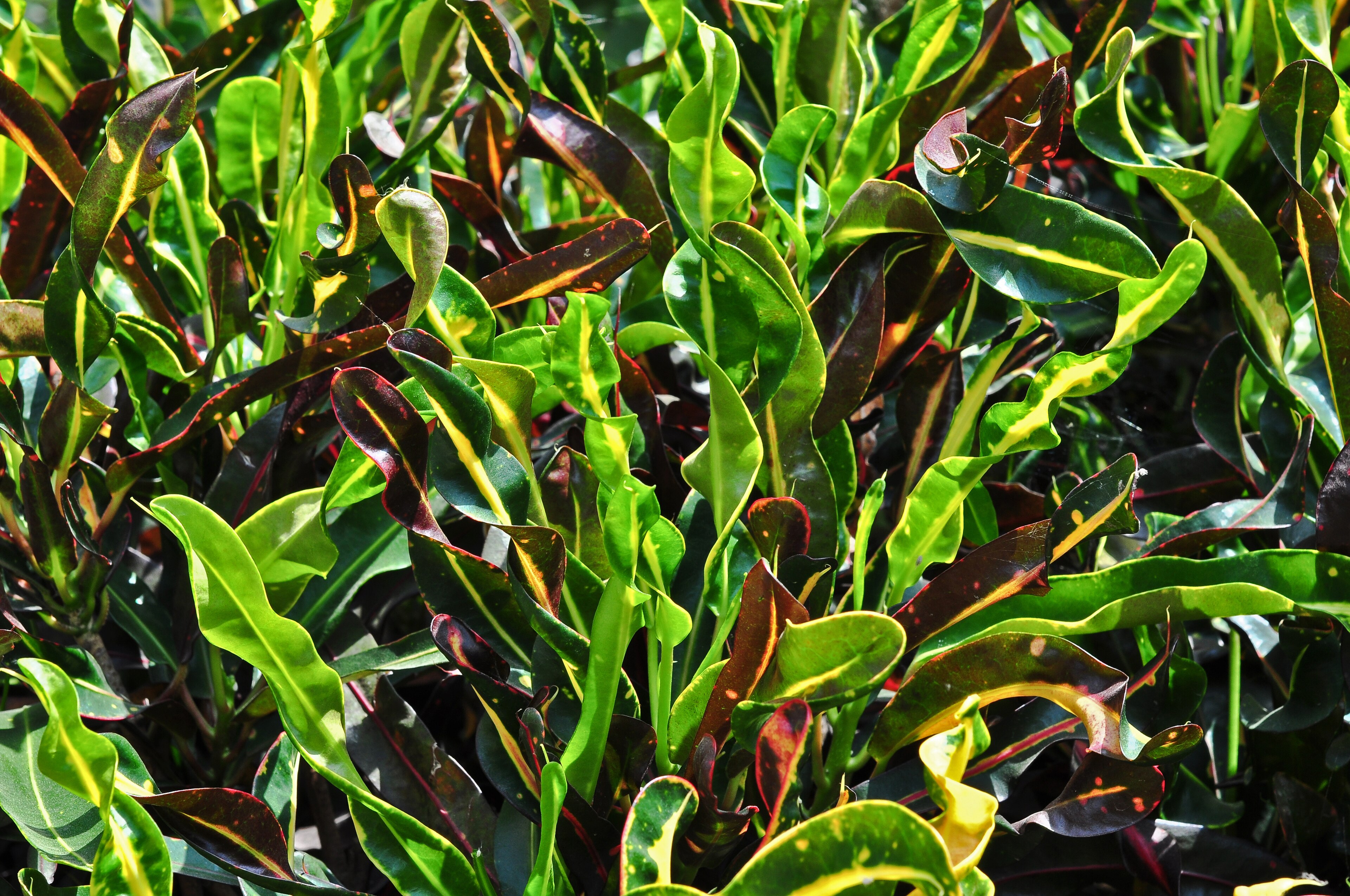
The tropical firework. Indoor plant with leaves variegated red, orange, yellow and green. Needs bright direct light, high humidity. HIGHLY toxic.
- Difficulty Moderate
- Light Bright indirect
- Watering Once a week
- Toxicity Toxic to cats
© Wikimedia Commons, free license (Joydeep, CC BY-SA 3.0)
Family
Euphorbiaceae
Origin
Southeast Asia, Pacific Islands, northern Australia
- tropical
- decorative foliage
- indoor plant
- colorful
- bright light
- toxic
The tropical firework
The Croton (Codiaeum variegatum) is the most colorful houseplant you can grow. Its thick glossy leaves explode in patterns of green, yellow, orange, fiery red, purple and sometimes pink or almost black. No other species combines so many vivid tones on a single plant. It is a living firework that turns a corner of your living room into a tropical jungle.
Native to the islands of Southeast Asia, the Pacific archipelagos and northern Australia, the Croton grows wild in warm humid tropical understory, in the bright zones of forest clearings. This origin explains its demanding character indoors: bright light, high humidity, constant warmth, no cold drafts.
The genus Codiaeum belongs to the Euphorbiaceae family, the same as the Poinsettia (Christmas star) and the Euphorbias. This botanical relationship has a direct consequence on its toxicity: like all Euphorbiaceae, the Croton produces an irritating milky sap that requires careful handling precautions.
Why these incredible colors
Croton colors are not a modern horticultural breeding artifact. They exist naturally in the wild, where they likely serve to attract pollinators or signal toxicity to herbivores. On a single plant, young leaves often appear light green or yellow, then gradually turn orange, red, and sometimes deep purple with age and exposure.
Color intensity depends directly on light received. This is the most important point to understand for success indoors. In bright direct light, red and yellow pigments (carotenoids and anthocyanins) fully express themselves. In light too dim, chlorophyll takes over and leaves turn uniformly green. Many beginners buy a flamboyant Croton at the garden center then watch it turn green within weeks at home. The problem is not the plant, it is insufficient light.
The most common varieties
More than 100 cultivars exist in commerce, but a few varieties dominate garden centers:
Croton Petra. The most well-known. Large pointed oval leaves, deep green veined with yellow, orange and red depending on maturity. Perfect variety to start with.
Croton Mammy. Narrow leaves twisted in spirals, mixing red, orange, green and purple. Very graphic look.
Croton Gold Dust. Deep green leaves dotted with small golden yellow spots like gold dust. More subtle, easier in average indoor light.
Croton Norma. Long narrow leaves, bright yellow striped with green. More delicate look.
Croton Sunny Star. Compact variety with apple green and intense yellow leaves, ideal for small spaces.
Croton Magnificent and Croton Excellent. Large oak-shaped lobed leaves, very rich palettes including deep purple.
All follow the same basic care but narrow-leaved varieties (Mammy, Norma) are more sensitive to humidity changes than wide-leaved varieties.
Light, watering, humidity
Light. Bright direct is essential to keep colors. Ideal: in front of a south, east or west-facing window with 2 to 4 hours of direct sun per day. Direct sun too intense in summer (south midday behind glass) can scorch leaves: a light sheer helps. In light too dim (more than 2 m from a window, room without direct sun), leaves lose their vivid colors and revert to green within weeks. See our dedicated article Croton losing color.
Watering. 1 to 2 times per week in summer, every 8 to 10 days in winter. Substrate should stay slightly moist but never waterlogged. Let the top 2 cm dry between waterings. Water at room temperature, ideally filtered or rainwater (Croton dislikes hard water that spots the leaves).
Humidity. HIGH essential: 60 to 80 percent. This is the other critical point. In dry air of heated apartments (30-40 percent in winter), leaves brown at tips and edges, mealybugs and spider mites settle in. Solutions: room humidifier, grouping with other tropical plants, tray of wet clay pebbles under the pot, daily misting with lukewarm non-calcareous water.
Substrate. Rich, well-draining, slightly acidic. Ideal mix: 50% potting soil for green plants + 30% leaf mold + 20% perlite. Pot with drainage required.
Temperature. 18 to 26 degrees Celsius ideal. Never below 15 degrees, never any cold draft (entryway, window open in winter). Below 12-13 degrees, Croton massively drops its leaves and can die.
Fertilizer. Every 2 to 3 weeks from April to September, green plant fertilizer at half dose or specific fertilizer for colored foliage plants (rich in potassium). In winter, stop completely.
The trap: massive leaf drop
If you buy a Croton and it loses half its leaves within two weeks, it is not dying. It is transition stress. Croton is the most sensitive houseplant to environmental changes: moving from garden center to home, change of light level, draft, humidity variation, and it defoliates immediately.
This is a survival behavior. The plant drops its most fragile leaves to save energy while it adapts. If you give it the right conditions (bright light, high humidity, no draft) and stop moving it, it will regrow leaves within 2 to 3 months. See the complete guide Croton dropping leaves.
Classic beginner mistake: moving the Croton from room to room to “find the right spot”. Each move triggers new leaf drop. Choose a definitive spot upon purchase and do not touch it for 3 months.
Growth and care
Growth moderate to fast in good conditions: 15 to 30 cm per year. Indoor height 60 cm to 1.80 m depending on variety and conditions. In the wild, Croton can reach 3 m as a shrub or small tree.
Repotting every 2 to 3 years in spring, in a pot 3-4 cm wider. Croton likes to be slightly snug in its pot.
Pruning: can be pruned in spring to bushify the plant. Cut overlong stems just above a node. WARNING: wear gloves. Irritating milky sap flows abundantly at the cut.
Cleaning the glossy leaves with a damp cloth once a month to maximize light capture and prevent mealybugs.
Propagation: by semi-hardwood stem cuttings in spring. Difficult, low success rate (20-40 percent). Dip the base in rooting hormone, plant in a humid mini-greenhouse at 25 degrees. Always wear gloves. For most amateurs, buying a new plant is simpler.
A dangerous plant for pets and children
Croton is one of the most toxic houseplants commonly sold at garden centers. Its milky sap contains phorbol esters and other irritating compounds characteristic of the Euphorbiaceae family.
For cats and dogs: ingestion causes severe vomiting, excessive salivation, diarrhea, sometimes blood in stools, lethargy, oral burns. See Croton toxic to cats and toxic to dogs.
For humans, especially children: sap on skin causes irritation, rash, sometimes burns. Eye contact: intense pain, risk of corneal damage. Ingestion by a child: vomiting, abdominal pain, mouth burns. Call Poison Control immediately.
Precautions:
- Place out of reach of pets and children
- Always wear gloves to prune, repot, propagate
- Wash tools after use
- Never burn pruning waste (irritating smoke)
- If sap on skin, rinse thoroughly with cold water
- If sap in eyes, rinse 15 minutes with clear water and consult
Common symptoms to watch
| Symptom | Likely cause | Solution |
|---|---|---|
| Massive leaf drop | Transition stress or draft | Stabilize environment, wait 2-3 months |
| Loss of vivid colors | Lack of light | Reposition near a window |
| Brown tips | Air humidity too low | Humidifier or misting |
| Sticky leaves | Mealybugs | Soap + alcohol |
| Webs under leaves | Spider mites | Misting + miticide |
| Soft drooping leaves | Acute water shortage | Water, monitor substrate |
Common problems and how Spriggo helps
Visual diagnosis remains the fastest method to identify a problem on Croton. The Spriggo app lets you photograph the affected area and get a diagnosis within seconds, with corrective actions to take. Discover Croton dropping leaves, Croton losing color, brown tips, watering protocol and mealybug treatment.
Diagnose this plant
-
Diagnosis
Croton brown tips: 5 causes (humidity first)
Brown tips on Croton: 60 percent dry air, hard water, underwatering, sun scorch, fertilizer salts. Diagnosis and solutions.
-
Diagnosis
Croton dropping leaves: why and what to do
Croton dropping leaves: 70 percent transition stress (moving, draft), low humidity, thermal shock. Diagnosis and solutions.
-
Diagnosis
Croton losing color: causes and solutions
Croton turning green: 80 percent lack of light. Exact diagnosis, concrete solutions to bring back the reds, oranges and yellows.
-
Toxicity
Is Croton toxic to cats? Yes, seriously
Croton and cats: high toxicity. Irritating milky sap, phorbol esters. Ingestion symptoms, immediate action, safe alternatives.
-
Disease
Mealybugs on Croton: identify and treat effectively
Croton mealybugs: identify cottony white clusters, sticky honeydew, black sooty mold. Complete treatment protocol and prevention.
-
Toxicity
Is Croton toxic to dogs? Yes, be careful
Croton and dogs: significant toxicity. Irritating milky sap with phorbol esters. Symptoms, vet emergency, safe alternatives.
-
Care
How to water a Croton: frequency, method, mistakes
Croton watering: 1 to 2 times per week in summer, every 8-10 days in winter. Filtered non-calcareous water. Substrate moist, never waterlogged.