
Araceae
Monstera
Monstera deliciosa
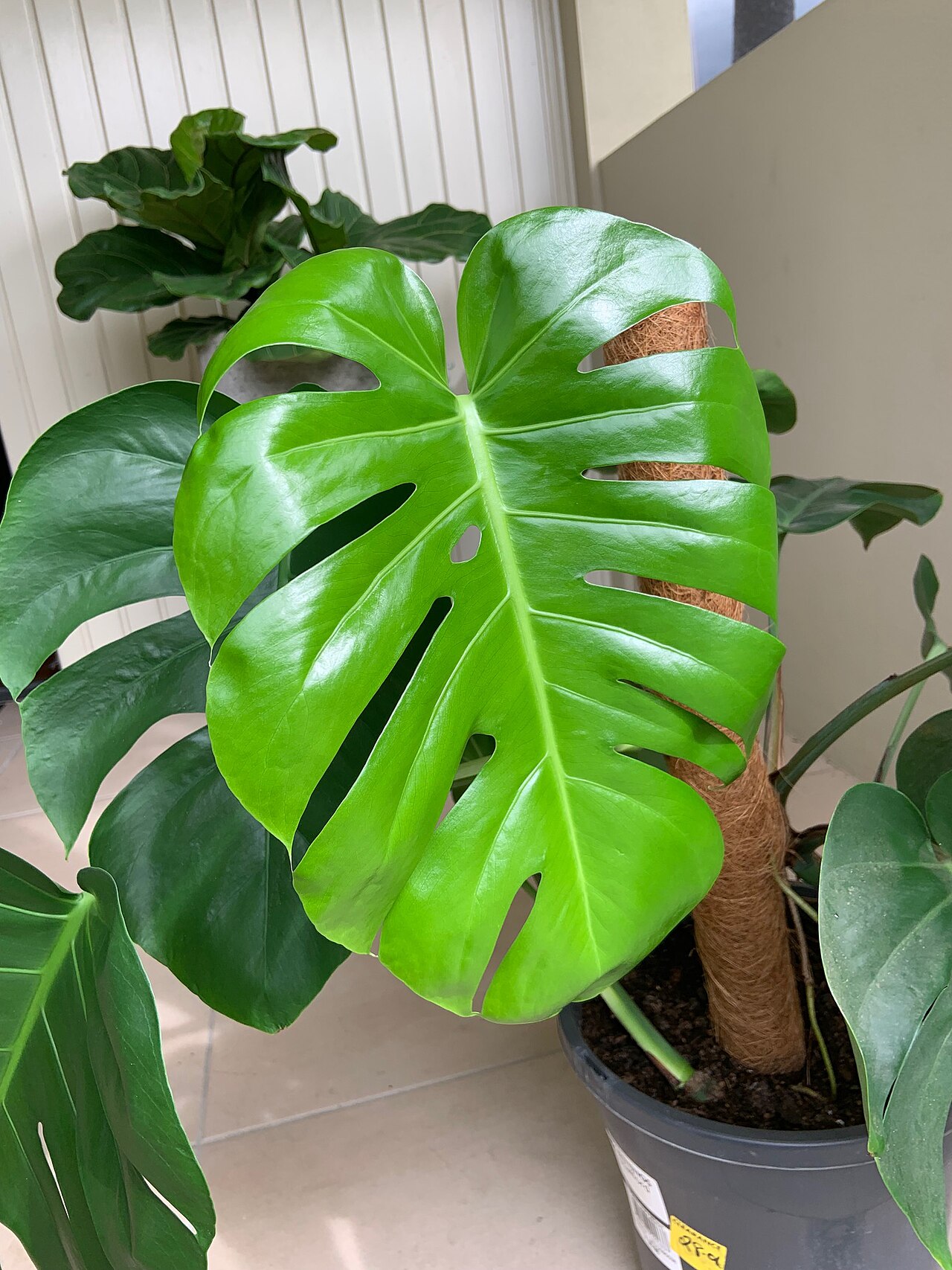
Queen of tropical houseplants, the Monstera deliciosa splits its own leaves to withstand the winds and rain of its native jungle. Easy-going, spectacular.
- Difficulty Easy
- Light Bright indirect
- Watering Once a week
- Toxicity Toxic to cats
© Kittykittymaomao, CC BY-SA 4.0
Family
Araceae
Origin
Tropical forests from southern Mexico to Panama
- tropical
- houseplant
- vine
- easy
- split leaves
A plant that splits its own leaves
The Monstera deliciosa is one of the rare plants that deliberately perforates its own leaves. In the tropical canopy, these slits, called fenestrations, let light and wind pass to the lower leaves, and reduce wind resistance during storms. They’re also what makes it one of the most iconic houseplants of the 21st century.
Native to forests from southern Mexico to Panama, it climbs tree trunks via aerial roots, sometimes more than twenty meters. Grown in a pot, it stays more modest, but can easily reach two meters tall in five years in a well-lit apartment.
How it really grows
The Monstera is a hemiepiphyte: it begins life as a terrestrial plant, then climbs a tree and eventually loses its ground roots. It then feeds via aerial roots that capture moisture from the air and anchor in bark crevices.
Two practical implications for you:
- It loves having a moss pole or coir support to climb. Without one, it sprawls and produces smaller leaves.
- Its aerial roots are not a defect. Cut them only if they bother you visually, never for “tidiness.”
The essentials of care
Light. Bright but indirect. An east or north-east window is ideal. Direct sun burns the leaves in hours, especially young growth. In a too-dark corner, new leaves emerge without fenestrations, the first sign your plant lacks light.
Watering. About once a week on average, but don’t follow the calendar: stick a finger in the substrate. The top two centimeters should be dry to the touch before the next watering. In winter, the interval can double.
Substrate. Airy, never heavy: 50% green plant compost + 25% pine bark + 25% perlite or pumice. The Monstera hates sitting in water.
Humidity. It tolerates the dry air of a heated apartment but thrives above 50% humidity. Brown tips usually mean the air is too dry.
Fertilizer. From March to October, a liquid green-plant fertilizer diluted by half, every three to four weeks.
What about kids, cats, dogs?
The Monstera contains calcium oxalate crystals in all its tissues. If ingested, these crystals cause an intense burning sensation in the mouth, heavy salivation, sometimes vomiting. Not fatal at reasonable doses, but very painful, a cat that chews a leaf rarely comes back.
If you have a curious cat or dog, place the plant up high, in a forbidden room, or pick a non-toxic alternative like the calathea, the areca palm or the Boston fern.
Common problems, and how Spriggo helps
The Monstera is hardy but it talks. Yellow leaves, brown leaves, black spots, soft stems: each symptom has a cause, and each cause its remedy. That’s exactly where the Spriggo app is useful: a photo of the suspect leaf, a diagnosis in seconds, and a tailored action plan.
Diagnose this plant
-
Disease
Anthracnose on Monstera: recognize Colletotrichum and stop it
Dark spots with concentric rings, yellow halo, fast spread: the anthracnose signature. Treatment protocol and propagation threshold.
-
Diagnosis
Black spots on Monstera: disease, parasite or physiological?
Small black spots, necrotic patches, or tiny dots: three cause families, three protocols. Identify fast to act before the plant declines.
-
Diagnosis
Browning Monstera leaves: what the affected zone tells you
Brown tips, dry edges, or brown spots in the middle: each zone reveals a different cause. A 4-step diagnostic method.
-
Living conditions
Monstera in low light: what it really tolerates
Does Monstera tolerate a dark corner? Yes, but at a cost. Survival threshold, warning signs, and choosing between moving the plant or adding a lamp.
-
Care
Repotting a Monstera: timing, method, and pitfalls
When to repot a Monstera, which pot, which substrate. Complete steps and classic mistakes that slow recovery.
-
Disease
Scale insects on Monstera: identify, treat, prevent recurrence
Small white clumps or brown bumps along the veins: Monstera is a favorite target of scale insects. Complete eradication protocol.
-
Disease
Spider mites on Monstera: the signature you must recognize
Speckled leaves, fine webbing between veins, plant looking dusty: spider mites. Diagnosis and complete treatment.
-
Toxicity
Monstera and cats: what to know before they take a bite
Monstera is toxic to cats due to calcium oxalates. Ingestion symptoms, emergency steps, and non toxic alternatives.
-
Toxicity
Monstera and dogs: ingestion, symptoms, what to do
Monstera is toxic to dogs, calcium oxalates. How to react if your dog chewed a leaf, and when to seek emergency vet care.
-
Care
Watering a Monstera deliciosa: the method that prevents root rot
When, how much, how to water a Monstera. There is no fixed frequency. Finger test method, seasonal adjustments, and warning signs.
-
Diagnosis
Yellow leaves on a Monstera: 6 causes, 6 precise fixes
Yellowing Monstera leaves? Overwatering, low light, deficiency, or natural aging, identify the real cause by looking at the yellowing pattern.