
Araceae
Pothos
Epipremnum aureum
Queen of indestructible houseplants, the pothos thrives in any light, tolerates skipped waterings, and silently filters indoor air.
- Difficulty Easy
- Light Indirect
- Watering Once a week
- Toxicity Toxic to cats
© Joydeep, CC BY-SA 3.0
Family
Araceae
Origin
Tropical forests of French Polynesia and the Solomon Islands
- tropical
- houseplant
- vine
- easy
- variegated leaves
- air purifying
The most tolerant houseplant in the world
The pothos has an enviable trait among houseplants: it forgives almost everything. Forget to water it for three weeks, it survives. Place it in a dark hallway, it still grows. Overwater it, it warns you gently before dying. This robustness explains why you find it in so many living rooms, offices, waiting rooms and restaurants. It is the plant chosen when nobody really has time to care for a plant.
Native to tropical forests of French Polynesia and the Solomon Islands, Epipremnum aureum is a climbing vine. In the wild, it wraps around trunks and can reach 20 meters long, with leaves that become enormous (up to 50 cm) once adult. In a pot, you rarely see it exceed 2 meters with leaves of 10 to 15 cm, because without a climbing support and without tropical light, it stays in its “juvenile” form indefinitely.
A poorly named plant
The scientific name has changed a lot. Long classified as Scindapsus aureus, then Pothos aureus, the species is now officially Epipremnum aureum. The common name “pothos” remained from the obsolete genus, and that is the word you look for at the garden center.
Several cultivars exist, all sold as “pothos”:
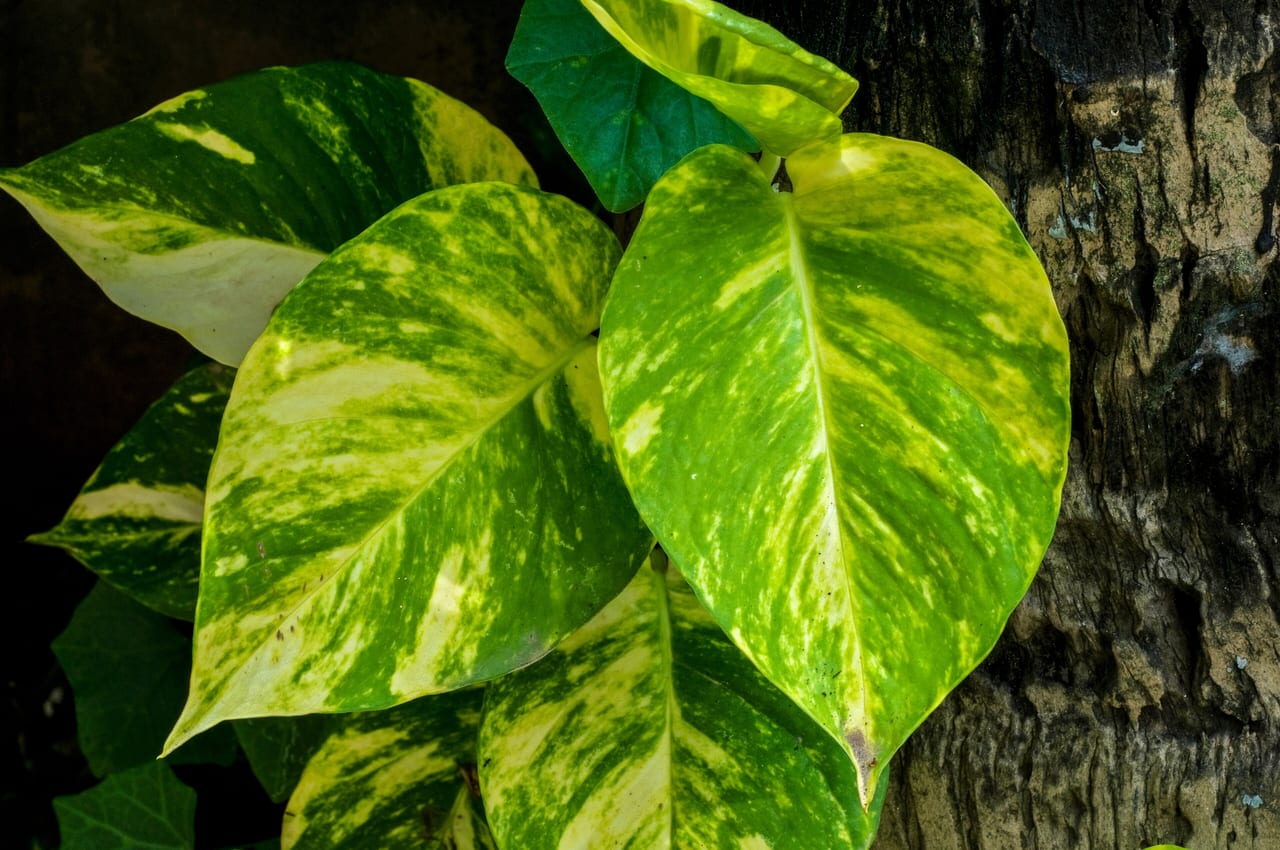
- Golden Pothos: the most common, medium green leaves marbled with creamy yellow. The one you see in the photo at the top.
- Marble Queen Pothos: very white leaves with green marbling. Grows slower due to low chlorophyll.
- Neon Pothos: entirely tender green leaves, almost fluorescent. No variegation.
- N’Joy or Pearls and Jade Pothos: smaller leaves, sharply drawn off-white.
- Cebu Blue Pothos: more elongated leaves, metallic blue green. Botanically Epipremnum pinnatum, a related but distinct species.
All are grown the same way.
Light, watering, substrate
The pothos tolerates a very wide light range. Ideal is bright indirect light: fast growth, well colored leaves, marked variegation. Medium light (2 to 3 m from a window) works too, growth slows a bit. In low light it survives long but loses the yellow variegation and new leaves come out almost entirely green. This is reversible: put it back in light and the next leaves will recover their marbling.
Watering follows the same rule as most aroids: let the top 2 to 3 cm of substrate dry between waterings. In practice that gives one watering every 1 to 2 weeks depending on season and light. The pothos warns you when thirsty: its leaves clearly droop, then straighten within hours of watering. It is the rare case where a plant serves as a reliable visual indicator.
For substrate, use an airy mix: 50 percent green plant potting soil, 25 percent perlite, 25 percent pine bark. Avoid heavy garden soil and pure potting soil, which retain too much water and suffocate roots.
On humidity, the pothos is one of the rare aroids that tolerates the dry air of a heated apartment well. No humidifier needed. If you maintain 40 to 50 percent, it will just be more exuberant.
Toxicity to cats, dogs, and children
The pothos contains calcium oxalate crystals in all its tissues, like most aroids (Monstera, Philodendron, Anthurium). If a cat or dog chews a leaf, the microscopic crystals plant themselves in the mouth mucous membranes and cause intense burning, abundant salivation, and sometimes vomiting.
This is very painful but rarely fatal in an adult animal. Serious risk concerns mainly kittens and puppies who have not learned to mistrust leaves, and who may swallow several mouthfuls. In case of suspected ingestion, rinse the mouth with fresh water and watch. Consult a veterinarian if swelling, repeated vomiting, or persistent lethargy.
For young children, same precautions: no leaf within mouth reach. The sap can also irritate sensitive skin, so gloves for pruning and repotting if your skin is reactive.
How it propagates
The pothos is one of the easiest plants to propagate. A stem cut just below a node, placed in a glass of water, develops roots within 7 to 14 days. Once roots measure 3 to 5 cm, you can plant in a pot with substrate. You can multiply indefinitely. It is an excellent gift for friends starting out with plants.
The aerial roots you see coming out of nodes on stems are normal: they are what lets the plant climb in the wild. On a pot, they serve nothing but decoration. You can cut them if they bother you, the plant survives.
Diseases and common problems
The pothos is hardy but not indestructible. Its typical problems:
Yellow leaves almost always signal overwatering. The plant prefers dry substrate to soaked substrate. Finger check before watering, 2 to 3 cm deep.
Brown leaves or dry tips indicate too dry air or excess limescale in tap water. Once a month with rainwater or filtered water, the problem disappears.
Stems softening at the base is the sign of advanced root rot. Take the plant out, cut all black soft roots, replant in fresh dry substrate. If more than 50 percent of roots are gone, take a healthy cutting and start a new plant.
On parasites, the pothos can be attacked by mealybugs (cottony in leaf axils) and spider mites (fine webs under leaves in heated winter). Monthly inspection, treatment with neem oil or insecticidal soap at the first sign.
For each specific symptom we have a dedicated article in the diagnostic section.
For Spriggo users
The Spriggo app identifies the pothos from a simple photo (useful if you have a cultivar and want to know which one), and diagnoses common problems in seconds. Particularly useful if you hesitate between pothos and philodendron, whose leaves look alike at first glance.
Diagnose this plant
-
Living conditions
Pothos in low light: what it keeps, what it loses
The pothos really tolerates shade, but at what cost. Survival threshold, warning signs, and choice between moving the plant or adding a lamp.
-
Disease
Mealybugs on pothos: identify and treat without killing the plant
Mealybugs love pothos. Here is how to spot them in time, the step-by-step treatment protocol, and durable prevention.
-
Care
Propagating a pothos in water: the foolproof method
The pothos is the easiest plant to propagate. Step-by-step method, timing, transplant, and mistakes to avoid.
-
Toxicity
Is pothos toxic to cats? Clear answer and what to do
Yes, pothos is toxic to cats (calcium oxalates). Ingestion symptoms, emergency steps and non-toxic alternatives.
-
Toxicity
Pothos and dogs: ingestion risks and emergencies
Pothos is toxic to dogs (calcium oxalates). How to react if your dog chewed a leaf, and when to seek urgent veterinary care.
-
Care
Watering a pothos: the finger test simplified
The pothos is one of the most forgiving plants for watering. The simple method that avoids the only fatal mistakes.
-
Diagnosis
Yellow leaves on a Pothos: 5 causes and the right fix
Your pothos leaves are yellowing? Overwatering, low light, natural aging, or deficiency: how to identify the real cause.