
Araceae
Flamingo flower
Anthurium andraeanum
The bright red flamingo flower: long-lasting waxy spathe, regular reblooming. Toxic to pets (Araceae).
- Difficulty Easy
- Light Indirect
- Watering Once a week
- Toxicity Toxic to cats
© Wikimedia Commons, free license
Family
Araceae
Origin
Tropical forests of Colombia and Ecuador
- tropical
- houseplant
- flowering
- easy
- air purifier
- epiphyte
The flamingo flower of indoor spaces
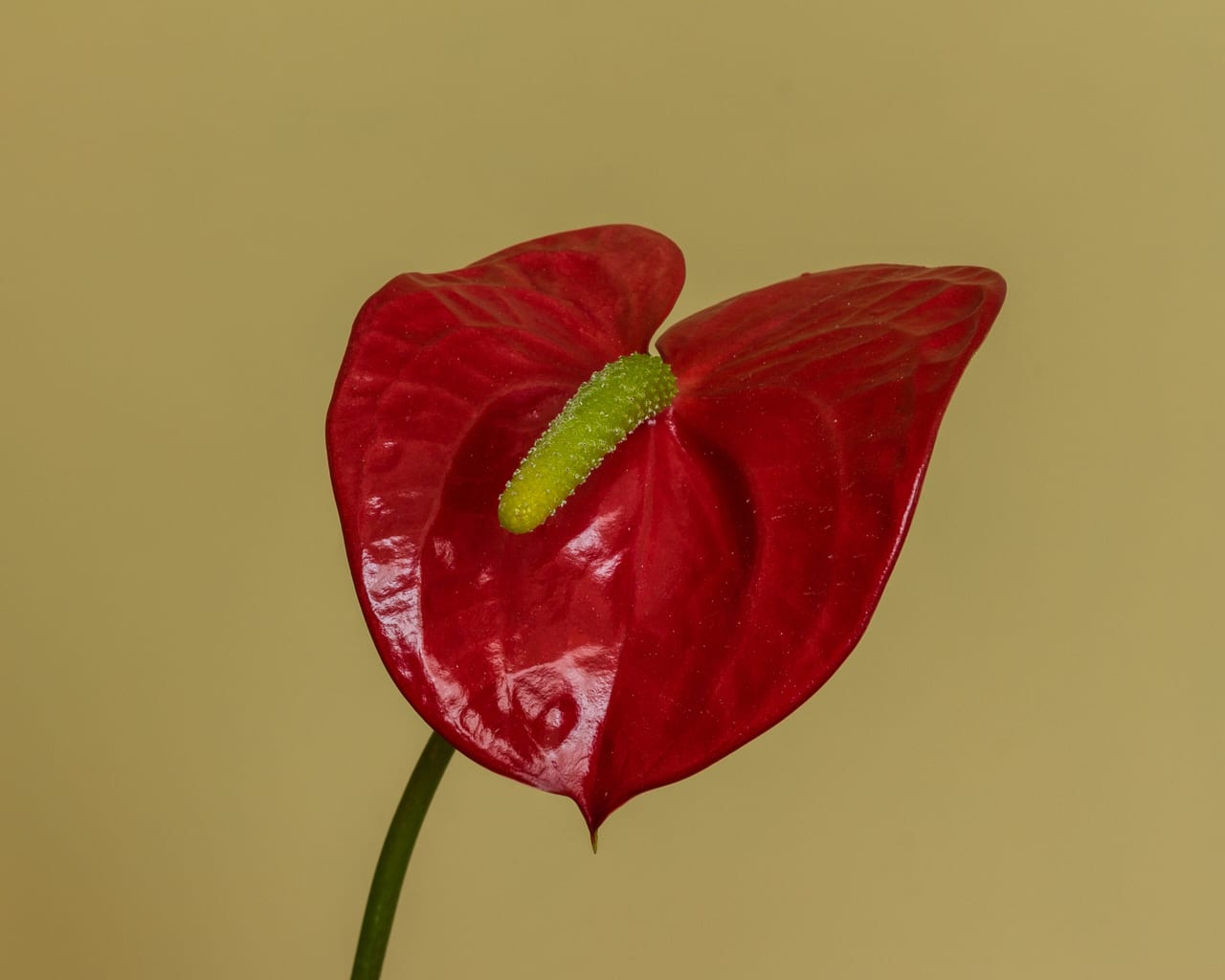
The Anthurium andraeanum, commonly called flamingo flower, flamingo lily, tail flower, or painter’s palette, is one of the most impressive flowering houseplants. Its bright waxy red spathe surrounds a characteristic central yellow-orange spadix, and lasts several weeks to several months on the plant.
Native to the humid tropical forests of Colombia and Ecuador, Anthurium andraeanum naturally grows as epiphyte or hemi-epiphyte: its roots cling to tree trunks and draw water and nutrients from humid air and decomposing organic matter. This adaptation explains its preference for very draining substrate and high ambient humidity.
Its silhouette is immediately recognizable: heart-shaped (cordate) leaves glossy dark green with long petioles, from which emerge the famous red, pink, white or purple spathes depending on cultivars (bright red remains the most iconic).
The spathe: it’s not a flower, it’s a bract
Botanically, the Anthurium “flower” is not a flower in the strict sense. It’s a spathe (modified colored bract) that surrounds the spadix, a small central spike covered with the actual tiny flowers. This structure characterizes the Araceae family (Spathiphyllum, Monstera, Pothos, Calla, Philodendron, Dieffenbachia share this floral architecture).
Difference with Spathiphyllum: Anthurium spathe is red, waxy, long-lasting (3-6 months), Spathiphyllum is white, tender (4-8 weeks).
Why so many choose it
Three durable success characteristics.
Long-lasting and frequent spathes. A well-cared adult plant blooms year-round with 4-8 simultaneous spathes each lasting 6-12 weeks. Almost always in bloom.
Signature color. Bright waxy red is a strong design statement, perfect for adding color in dark or minimalist interiors.
Symbolic plant. In several cultures, Anthurium symbolizes hospitality, passionate love (red), purity (white). Classic housewarming gift.
Light, watering, substrate
Light. Bright indirect. Ideal: 1-2 m from east, west or south window with sheer curtain. Bright light is essential for reblooming. Tolerates darker but stops blooming within months. Direct south sun to avoid (leaves brown).
Watering. Every 5-7 days in summer, every 8-10 days in winter. Substrate should stay slightly moist (not saturated). Rainwater or filtered water preferable.
Substrate. VERY draining, like for orchids. Mix: 40% pine bark (orchid mix), 30% potting soil, 20% perlite, 10% sphagnum moss. Pot with drainage mandatory. Classic mistake: ordinary too-dense substrate → roots rot.
Humidity. MANDATORY HIGH (60-80%). The critical point for Anthurium. In dry apartment air, daily misting, humidifier recommended, pebble tray with water under pot.
Temperature. 18 to 25 degrees. Not below 15 degrees (cold-sensitive).
Fertilizer. Every 15 days April through September, flowering plant fertilizer rich in phosphorus (NPK type 10-30-20) at half-dose. Essential for reblooming.
Growth and care
Growth moderate: 4-6 new leaves per year. Adult height 30-60 cm.
Repotting every 2-3 years, in spring. Choose pot 2-3 cm wider. Very draining substrate essential.
Division: propagation method. At repotting, gently separate lateral offsets with their own roots. Replant each offset.
Cut faded spathes: at base of stalk with disinfected scissors when spathe has turned green then completely brown. Plant devotes energy to next spathe.
Common symptoms to watch
| Symptom | Likely cause | Solution |
|---|---|---|
| No red spathes | Lack of light or fertilizer | Reposition, fertilize |
| Green spathes from opening | Insufficient light | Reposition |
| Yellow leaves | Overwatering | Inspect roots |
| Brown tips | Dry air or hard water | Humidify, filtered water |
| Brown soft leaves | Root rot | Repotting emergency |
| Mealybugs | Dry air, isolation | Insecticidal soap |
A toxic plant for pets
Like all Araceae (Spathiphyllum, Monstera, Pothos, Anthurium, Calla, Dieffenbachia, Philodendron), Anthurium contains calcium oxalate crystals in all parts. Ingestion by cat or dog causes:
- Immediate intense oral irritation
- Excessive salivation
- Vomiting
- Sometimes lip or tongue swelling
Mortality rare but marked discomfort 24-48h. The bright red spathe is particularly tempting for curious cats and puppies. Keep out of reach. See Anthurium toxic to cats and to dogs.
Diagnose this plant
-
Diagnosis
Anthurium brown leaves: 4 causes (water and dry air)
Brown leaves Anthurium: too dry air first, hard water, direct sun, or rot. Diagnosis and solution.
-
Diagnosis
Anthurium green spathes instead of red: light (90%)
Green spathes Anthurium: insufficient light in 90 percent of cases. Anthocyanin pigment mechanism and complete solution.
-
Disease
Mealybugs on Anthurium: eliminate in 4 weeks
Mealybugs on Anthurium: recognize white cottony clusters, treat with insecticidal soap + alcohol, prevent. Complete plan.
-
Diagnosis
Anthurium not flowering: 5 causes (light and phosphorus)
Anthurium without red spathes: lack of light in 50 percent of cases, phosphorus deficiency, young plant, large pot, winter rest.
-
Toxicity
Is Anthurium toxic to cats? (yes, calcium oxalates)
Anthurium is toxic to cats. Calcium oxalate crystals throughout plant. Red spathe particularly attractive. Emergency steps.
-
Toxicity
Is Anthurium toxic to dogs? (yes, oxalates)
Anthurium is toxic to dogs. Calcium oxalate crystals throughout plant. Symptoms, emergency steps, alternatives.
-
Care
Watering an Anthurium: frequency, water, epiphyte substrate
Every 5-7 days in summer, 8-10 in winter. Very draining substrate (orchid mix). Filtered water. Humidity 60-80% mandatory.
-
Diagnosis
Anthurium yellow leaves: 4 causes (water in 60% of cases)
Yellow leaves on Anthurium: overwatering in 60 percent of cases, aging, lack of light, or deficiency. Exact diagnosis.