
Araceae
Heart leaf philodendron
Philodendron hederaceum
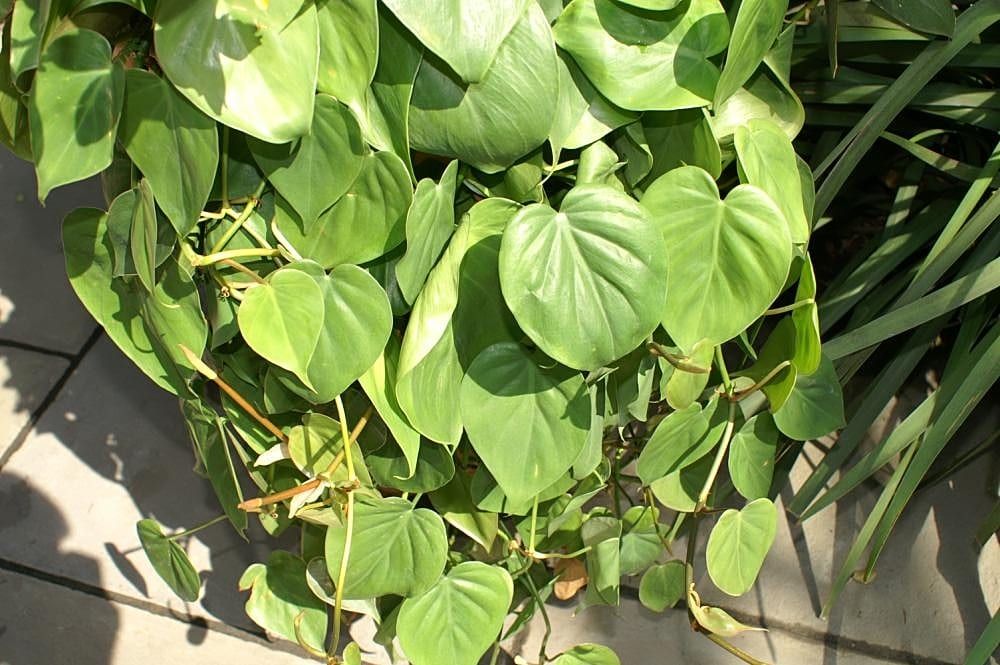
The climbing philodendron with heart-shaped leaves. Tolerant, easy, fast-growing. Toxic to pets. Direct cousin of Pothos.
- Difficulty Easy
- Light Indirect
- Watering Once a week
- Toxicity Toxic to cats
© Photo by David J. Stang, CC BY-SA 4.0
Family
Araceae
Origin
Central America, Caribbean, southern Mexico
- tropical
- houseplant
- vine
- easy
- heart leaves
- air purifier
The vine that asks for almost nothing
The heart leaf philodendron (Philodendron hederaceum, formerly Philodendron scandens or Philodendron oxycardium) is one of the world’s best-selling houseplants, on par with its lookalike the Pothos. Characteristic: heart-shaped leaves of 5-15 cm, glossy tender green, on climbing or trailing stems reaching 4 meters indoors.
Native to Central America (southern Mexico to Panama) and the Caribbean, philodendron grows in tropical rainforests, climbing tree trunks via aerial roots. A facultative epiphyte: can grow at ground level or as climber.
Cultivated indoors since the 19th century, one of the first office and living room green plants. Today, several colorful cultivars (Brasil, Birkin, Lemon Lime) decline the base variety.
Philodendron, Pothos, Monstera: don’t confuse
Three climbing Araceae often confused. How to distinguish:
Heart leaf philodendron: heart-shaped leaves thin and supple, no variegation (solid green, except cultivars). Fine fast growth. Rounded petiole. Thin aerial roots.
Pothos (Epipremnum aureum): heart-shaped leaves thick and tough, often variegated yellow or cream. Vigorous growth. Petiole with groove. Thick aerial roots.
Monstera (Monstera deliciosa): much larger leaves (20-50 cm), split (fenestrated) at maturity. Not strictly heart-shaped. Thick rigid stems.
Philodendron scandens is more delicate and finer than Pothos, smaller than Monstera.
Why so many choose it
Three characteristics explain its massive success.
Tolerates almost anything. Low light, occasional missed watering, dry air, AC: the plant survives. Ideal for beginners and distracted owners.
Fast spectacular growth. 30-60 cm new stems per year in good conditions. Decorative “cascade” effect within months if hung.
Very easy propagation. Simple stem cutting in water roots in 2-4 weeks. Endless multiplication for gifting.
Light, watering, substrate
Light. Bright indirect or moderate. Ideal: 1-2 meters from east window, or any window behind sheer. Tolerates low light (hallway, bathroom), but slower growth. Direct south sun to avoid in summer (burns).
Watering. Every 7-10 days in summer, every 12-18 days in winter. Substrate should be slightly moist without soaking. Finger test: dry over 2-3 cm = water. Method: water generously, drain, empty cachepot. Overwatering = root rot.
Substrate. Light and draining. Mix: 50% green plant potting mix, 30% perlite, 20% coconut fiber. Pot with drainage holes.
Humidity. Moderate to high ideal (50-70%). Tolerates apartment air (40-50%) without complaint. Occasional misting welcome but not essential.
Temperature. 18-26 degrees ideal. Not below 12 degrees. Sensitive to cold drafts.
Fertilizer. Once a month in growing season (April-September), green plant fertilizer at half-dose. Not in winter.
Growth and care
Fast growth: 30-60 cm per year. Adult height/length 2-4 meters in pot. Can be pruned to stay compact.
Moss pole: to climb, install vertical moss pole. Aerial roots grip and leaves become larger.
Hanging: alternative for decorative cascade. Stems trail elegantly.
Repotting every 2-3 years, in spring. Choose pot 2-3 cm larger.
Propagation by cutting: the king method
One of philodendron’s great pleasures: cutting is ridiculously easy.
- Cut healthy stem 10-15 cm with 2-3 nodes (bumps where leaves emerge)
- Remove bottom leaves to expose 1-2 nodes
- Place in glass of room temperature water, nodes submerged
- Place in bright indirect light
- Change water every 5-7 days
- Roots appear in 2-4 weeks from submerged nodes
- When roots are 5 cm, replant in pot with moist substrate
- Recovery guaranteed
Success rate near 100%.
Common symptoms to watch
| Symptom | Likely cause | Solution |
|---|---|---|
| Yellow leaves | Excess water or aging | Space out, check roots |
| Brown leaves | Tap water, direct sun, dehydration | Identify precisely |
| Soft stems | Rot | Cut, root healthy parts |
| Halted growth | Light deficiency or nutrients | Reposition, fertilize |
| Mealybugs | Dry air, isolation | Insecticidal soap treatment |
| Smaller leaves | Light deficiency, mature plant without pole | Reposition, add pole |
A toxic plant for pets
Like all Araceae (Monstera, Pothos, Anthurium), Philodendron contains calcium oxalate crystals throughout. Ingestion by cat or dog: immediate intense oral irritation, salivation, vomiting, sometimes edema. Symptoms last 24-48h, mortality rare.
Place plant out of reach of animals and young children. See detailed articles Philodendron toxic to cats and Philodendron toxic to dogs.
Diagnose this plant
-
Diagnosis
Heart leaf philodendron with brown leaves: 4 causes diagnosed
Brown leaves on philodendron: dry air, hard tap water, direct sun, or fungus. Diagnosis and action plan.
-
Disease
Mealybugs on heart leaf philodendron: identify, treat, prevent
Mealybugs on Philodendron: pest #1, favored by dry air. Identify white clumps, treat with insecticidal soap, prevent.
-
Care
Propagating heart leaf philodendron: 100% guaranteed method
Complete philodendron propagation guide. Water method, roots in 2-4 weeks, near-perfect success rate. Step by step.
-
Toxicity
Heart leaf philodendron toxic to dogs: protocol and precautions
Philodendron TOXIC to dogs. Calcium oxalate crystals cause oral irritation, salivation, vomiting. Emergency protocol.
-
Toxicity
Heart leaf philodendron toxic to cats: protocol and precautions
Philodendron TOXIC to cats. Calcium oxalate crystals cause oral irritation, salivation, vomiting. Emergency protocol.
-
Care
Watering a heart leaf philodendron: frequency, method, mistakes
Complete philodendron watering guide. Every 7-10 days summer, 12-18 winter. Mandatory finger test.
-
Diagnosis
Heart leaf philodendron with yellow leaves: 4 causes diagnosed
Yellow leaves on philodendron: overwatering in 60 percent of cases, aging, light deficiency, or nutrient deficiency. Diagnosis and solution.