
Asparagaceae
Madagascar dragon tree
Dracaena marginata
The miniature indoor tree: slender sculptural trunk and linear red-edged leaves. Tolerates neglect. Toxic to pets.
- Difficulty Easy
- Light Indirect
- Watering Sparse
- Toxicity Toxic to cats
© H. Zell, CC BY-SA 3.0
Family
Asparagaceae
Origin
Madagascar
- tropical
- houseplant
- easy
- low light
- architectural
- air purifier
The miniature tree that forgives everything
Dracaena marginata, commonly called the Madagascar dragon tree or simply dragon tree, is one of the most forgiving houseplants in the world. Its miniature-tree silhouette with a slender ramified trunk and bouquets of long red-edged linear leaves has made it a houseplant classic for 50 years, from corporate offices to family living rooms.
Native to Madagascar and Mauritius, Dracaena marginata grows wild in rocky areas and open understory. This adaptation explains its exceptional tolerance to forgotten waterings, dry air, and moderate light. It’s typically the plant your grandmother had and you’ll find still alive 10 years later.
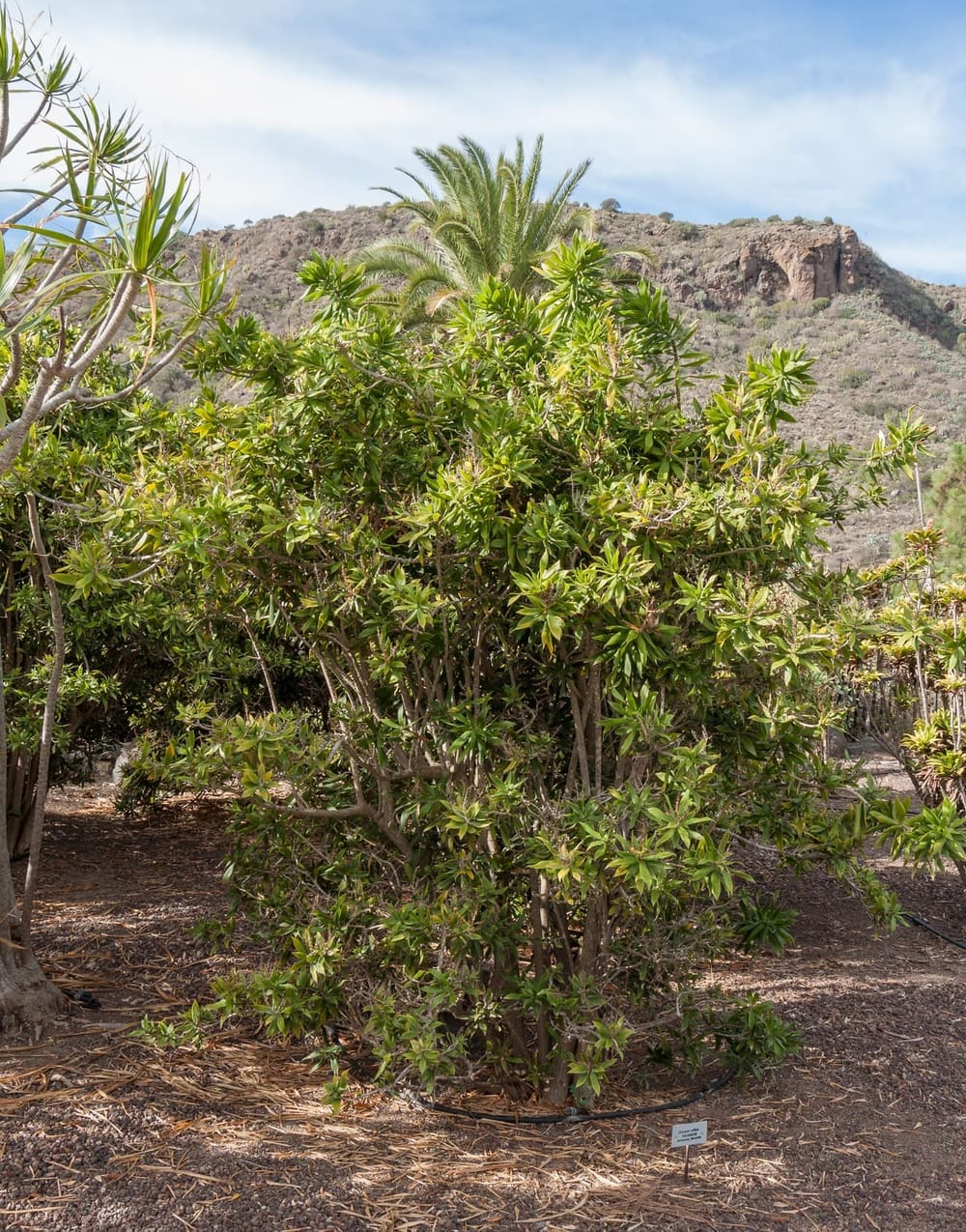
Its silhouette is immediately recognizable: slender ramified trunk (often multi-stemmed), with beige-gray bark, topped with bouquets of narrow leaves 30 to 60 cm long, glossy dark green edged with burgundy red. This red edge is the species marker (the “Tricolor” cultivar adds a cream stripe, and “Colorama” is almost entirely pink).
Slow architectural growth
Dracaena marginata grows very slowly: only 5 to 15 cm per year. This slowness is an advantage: the plant stays the same size for years without urgent repotting, and investment in a mature specimen is durable.
Adult indoor height: 1.50 to 3 meters (in the wild, can reach 6 meters). The multi-stem sculptural form develops naturally over time: old leaves drop, leaving annular scars on the trunk, which branches after each pruning (if you do any).
Why so many choose it
Four characteristics explain its decades of success.
Tolerates forgotten waterings. Easily survives 3-4 weeks without water in winter. Leaves go slightly soft then rise back within days after watering. Ideal for travelers and forgetful beginners.
Tolerates moderate light. No need for a south window. A room with indirect natural light suffices. Survives even in offices with partial artificial lighting.
Sculptural architecture. Its miniature-tree silhouette brings strong vertical presence to a room, unlike bushy plants. Photogenic and statement design.
Recognized air-purifier. NASA Clean Air studies (1989) confirm Dracaena marginata’s effectiveness at filtering formaldehyde, xylene, trichloroethylene. Not magical, but real.
Light, watering, substrate
Light. Moderate to bright indirect. Ideal: 1-2 meters from an east, west or north window. Tolerates darker spots (3-4 meters from window) but slower growth and less marked red edges. Direct south sun to avoid (leaves discolor and brown).
Watering. Every 10 to 14 days in summer, every 18 to 21 days in winter. Substrate should dry on surface between waterings (finger test at 3 cm). Classic mistake is overwatering: Dracaena prefers slight drying over saturation. Rainwater or filtered water preferable, limescale and fluoride brown the tips.
Substrate. Draining. Mix: 50% green plant potting mix, 30% perlite, 20% coarse sand. Pot with drainage holes mandatory.
Humidity. Tolerates dry air (30-40%). Ideal 40-60% but no obsession needed. Occasional misting welcome in heated winter.
Temperature. 18 to 26 degrees ideal. Not below 13 degrees. Sensitive to cold drafts.
Fertilizer. Once every 2 months in growing season (April-September), green plant fertilizer at half-dose. Not in winter. Dracaena grows slowly and is not a heavy feeder.
Growth and care
Growth: 5 to 15 cm per year. Adult height 1.50 to 3 meters indoors after 10 to 20 years.
Repotting every 3 to 4 years, in spring. Slow growth allows spaced repotting. Pot 2-3 cm wider.
Pruning: to limit height or branch out, cut the trunk at the desired height with disinfected pruners (above an annular scar). The plant regrows by forming 2 to 4 new heads at the cut point. The cut stem can be propagated.
Propagation: cut a 15-30 cm trunk portion, let dry 2-3 days, plant in moist draining substrate. Roots in 4 to 8 weeks.
Leaf cleaning: gently wipe with lukewarm water once a month to remove dust (smooth surface characteristic of linear leaves).
Common symptoms to watch
| Symptom | Likely cause | Solution |
|---|---|---|
| Brown tips | Hard water or fluoride | Filtered water |
| Yellow base leaves | Normal aging | Cut |
| All leaves yellow | Overwatering | Inspect roots |
| Brown soft leaves | Root rot | Emergency repot |
| Discolored leaves | Direct sun | Reposition |
| Halted growth | Lack of light | Reposition |
| Mealybugs | Dry air, isolation | Insecticidal soap |
A VERY toxic plant for pets
Dracaena marginata is more toxic than Araceae for cats and dogs. Main toxin: steroidal saponins (different from Araceae calcium oxalates).
Specific symptoms:
- Vomiting, sometimes bloody in cats
- Excessive salivation
- Anorexia, depression
- Characteristic dilated pupils in cats
- Weakness, ataxia
Symptoms can last 24 to 72 hours. Mortality remains rare but discomfort is severe and dehydration from repeated vomiting may require veterinary consultation.
Keep absolutely out of reach of pets. See detailed articles Dragon tree toxic to cats and Dragon tree toxic to dogs.
Diagnose this plant
-
Diagnosis
Dragon tree (Dracaena marginata) brown leaves: 4 causes (tap water mostly)
Brown leaves on Dragon tree: hard or fluoridated water in 60 percent of cases, overwatering, direct sun, or aging. Exact diagnosis.
-
Diagnosis
Dragon tree brown tips: 4 causes (fluoride first)
Brown tips on Dracaena marginata: tap water fluoride in 70 percent of cases, dry air, over-fertilization, or hydric stress. Solutions.
-
Living conditions
Dracaena marginata in low light: what works, what doesn't
Dragon tree tolerates low light well but with trade-offs. Optimal position, warning signals, alternatives, grow lights.
-
Disease
Mealybugs on Dracaena marginata: eliminate in 4 weeks
Mealybugs (mealy and scale) on Dragon tree: recognize, treat with insecticidal soap + alcohol, prevent. Complete 4-week plan.
-
Toxicity
Is Dracaena marginata toxic to cats? (yes, saponins, more serious)
Dragon tree more toxic than Araceae for cats. Steroidal saponins: vomiting (sometimes bloody), dilated pupils, depression. Emergency.
-
Toxicity
Is Dracaena marginata toxic to dogs? (yes, saponins)
Dragon tree toxic to dogs. Steroidal saponins: vomiting, salivation, depression. Less severe than cats but supervision needed.
-
Care
Watering Dracaena marginata: frequency, water, complete method
Every 10-14 days in summer, 18-21 in winter. Fluoride-free water mandatory. Complete method season by season.
-
Diagnosis
Dragon tree yellow leaves: 4 causes (water in 70% of cases)
Yellow leaves on Dracaena marginata: overwatering in 70 percent of cases, aging, lack of light, or deficiency. Diagnosis and corrective plan.