
Apocynaceae
Hoya carnosa
Hoya carnosa
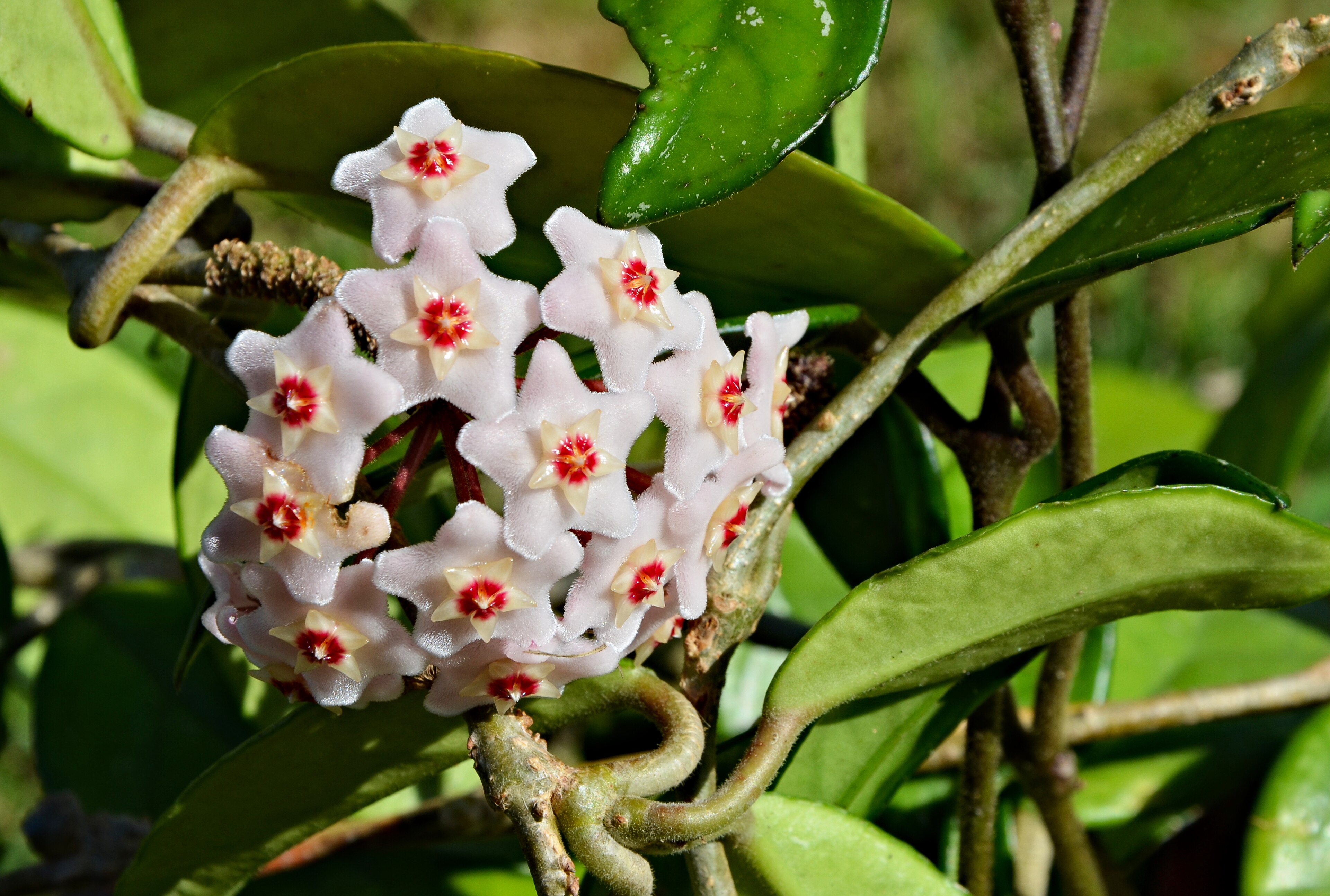
The porcelain flower. Succulent climbing plant with fragrant waxy pink umbel flowers. NON-toxic to cats and dogs. Very easy.
- Difficulty Easy
- Light Bright indirect
- Watering Sparse
- Toxicity No known hazard
© Wikimedia Commons, free license (JLPC, CC BY-SA 3.0)
Family
Apocynaceae
Origin
Southeast Asia (India, southern China, Vietnam, Thailand, Indonesia)
- non toxic
- easy
- climbing
- succulent
- fragrant flowers
- long lived
The porcelain flower
Hoya carnosa, better known as porcelain flower or wax plant, is one of the most spectacular flowering houseplants. Its perfectly geometric umbels gather 15 to 30 small star-shaped waxy flowers, pale pink with crimson red centers, releasing a sweet heady fragrance in the evening. A single umbel can stay in bloom for several weeks.
Native to humid tropical forests of Southeast Asia (India, southern China, Vietnam, Thailand, Indonesia), Hoya carnosa grows in the wild as an epiphytic vine on tree trunks, clinging with aerial roots. This epiphytic origin explains its atypical care: bright light, rare watering, very draining substrate, roots that dislike being in dense soil.
The species belongs to genus Hoya (family Apocynaceae, like oleander and periwinkle). The genus counts over 300 species, of which carnosa is by far the most cultivated indoors. Robert Brown described the species in 1810 and named it after English botanist Thomas Hoy, head gardener to the Duke of Northumberland.
Exceptional longevity
Hoya carnosa is one of the longest-lived houseplants: a well-cared specimen can live 50 to 100 years. Many Hoyas are passed down through generations in families, like living heirlooms. Their slow growth (10 to 30 cm per year) makes them patient plants that visually enrich over the years.
This longevity is explained by their succulent biology: fleshy water-storing leaves, economical roots, slow metabolism, resistance to moderate variations. Once adapted to its spot, a Hoya can live without repotting for 5 to 10 years and tolerate occasional watering oversights.
Flowering: magical but conditional
This is the point that separates a decorative Hoya from a magical Hoya. Without flowering, the dark green waxy foliage remains nice but ordinary. With flowering, the Hoya becomes one of the most spectacular plants in a home.
Flowering conditions:
- Plant aged 3 to 5 years minimum (young ones do not flower)
- Bright light with several hours of indirect or mild direct sun per day
- Period of mild water stress in late autumn and winter (extended drying between waterings)
- Phosphorus-rich fertilizer in early spring
- Never cut the peduncles of past flowers: they rebloom from the same spot each year
See the full guide Hoya not flowering for diagnosis and restart solutions.
Light, watering, substrate
Light. Bright indirect with a few hours of mild direct sun ideal. East or west window. South with light sheer in summer. Avoid direct midday summer sun which can scorch leaves. In insufficient light (more than 2 m from window, pure north), plant survives but never flowers and grows very slowly.
Watering. Every 10 to 14 days in summer, every 3 to 4 weeks in winter. Hoya is succulent: its fleshy leaves store water. Substrate must dry completely between waterings. Most common mistake: overwatering. Root rot is the number one cause of death.
Humidity. Medium sufficient: 40 to 60 percent. Hoya tolerates dry heated apartment air, unlike true tropicals (Croton, Calathea, Anthurium). No humidifier needed as a rule.
Substrate. Very draining, cactus or orchid type. Ideal mix: 40% green plant soil + 30% perlite + 20% orchid bark + 10% pumice. Pot with drainage required.
Temperature. 18 to 26 degrees Celsius ideal. Tolerates 12 to 30 degrees. Avoid cold drafts and sudden changes.
Fertilizer. Every 3-4 weeks April to September, flowering plant fertilizer half-dose (rich in phosphorus and potassium to promote blooming). In winter, stop completely.
The absolute rule: NEVER cut peduncles
This is the number one beginner mistake. When a Hoya umbel finishes blooming, the flowers fall but the peduncle remains, a short woody stub of 3-5 cm. Temptation: cut for aesthetics. Fatal mistake: this same peduncle will produce new umbels every year from the same spot, sometimes for 10 years or more.
Cutting the peduncle = losing the flowering station forever. Plant will have to reform a new peduncle elsewhere, which takes 1-2 years.
Simple rule: cut nothing on a Hoya unless stem is clearly dead (dry brown, no leaves, no green tissue under bark scraped with fingernail).
Common varieties
Hoya carnosa Krimson Queen: leaves with white-pink-green variegation on edges. Very popular variation.
Hoya carnosa Krimson Princess: variegated leaves with cream-pink-white center and green border. Reverse of the Queen.
Hoya carnosa Tricolor: highly contrasted pink-white-green variegation.
Hoya carnosa Compacta (Hindu Rope): leaves twisted in tight spiral, “rope” look. Very distinctive variation.
Hoya carnosa Wilbur Graves: leaves with silvery cream marbling on dark green background.
All follow the same care as standard carnosa, but variegated varieties are more light-demanding to maintain their colors (without enough light they revert to green).
Propagation by cutting
Hoya carnosa is one of the easiest plants to propagate.
Stem with node method:
- Cut a stem with at least 2-3 nodes (buds where leaves emerge)
- Remove leaves from the lowest node
- Dip base in water or plant directly in moist substrate
- Roots visible in 3-6 weeks
- Transplant when roots reach 2-3 cm
Ideal period: spring to early summer. 80 percent success rate.
A 100 percent safe houseplant
Hoya carnosa is one of the rare flowering houseplants without any recognized toxicity for humans, cats and dogs.
For cats: NON-toxic per ASPCA. See Hoya non-toxic to cats.
For dogs: NON-toxic per ASPCA. See Hoya non-toxic to dogs.
For humans: no known toxic compound. White milky sap is rich in natural latex but without recognized toxicity. Minor precaution: may stain clothes and very slightly irritate very sensitive skin (rare case). Always wear glove if latex-allergic.
Precautions: none particular. Plant can be handled and propagated without gloves as a rule. For very sensitive skin, gloves recommended when pruning or propagating.
Common symptoms to watch
| Symptom | Likely cause | Solution |
|---|---|---|
| Does not flower | Young plant or insufficient light | Wait, reposition in bright light |
| Yellow leaves | Excess water most often | Space out watering |
| Wrinkled soft leaves | Prolonged underwatering | Rehydrate by soaking |
| Leaves dropping | Thermal shock or rot | Stabilize, check roots |
| Stopped growth | Normal winter or lack of light | Wait, reposition |
| Mealybugs | Dry air + isolation | Black soap + alcohol |
| Flower buds dropping | Move or variations | Stabilize, do not touch again |
Common problems and how Spriggo helps
Visual diagnosis remains the fastest method to identify a problem on Hoya. The Spriggo app lets you photograph the affected area and get a diagnosis within seconds, with corrective actions to take. Discover Hoya not flowering, yellow leaves, wrinkled leaves, watering protocol and mealybug treatment.
Diagnose this plant
-
Disease
Mealybugs on Hoya: identify and treat effectively
Hoya mealybugs: identify cottony white clusters, alcohol 70 + black soap treatment, complete protocol in 4 weeks.
-
Diagnosis
Hoya not flowering: 6 causes and how to trigger blooms
Hoya not flowering: 50 percent plant too young, lack of light, cut peduncles, excess fertilizer, conditions too stable. Diagnosis and solutions.
-
Toxicity
Is Hoya toxic to cats? No, safe plant
Hoya carnosa and cats: NON-toxic. Listed safe by ASPCA. Confirmed safety for households with cats. Precautions and alternatives.
-
Toxicity
Is Hoya toxic to dogs? No, risk-free
Hoya carnosa and dogs: NON-toxic. Listed safe by ASPCA. Confirmed safety for dog households. Minor precautions and alternatives.
-
Care
How to water a Hoya: frequency, method and mistakes to avoid
Hoya carnosa watering: every 10-14 days in summer, every 21-28 days in winter. Substrate dried completely between waterings. Room-temp water.
-
Diagnosis
Hoya with wrinkled leaves: dehydration and other causes
Wrinkled leaves on Hoya: 70 percent prolonged underwatering, damaged roots, thermal shock, or light stress. Diagnosis and fast solutions.
-
Diagnosis
Hoya with yellow leaves: 4 causes and solutions
Yellow leaves on Hoya: 65 percent overwatering, thermal shock, aging, or lack of light. Exact diagnosis and action.