
Commelinaceae
Tradescantia zebrina
Tradescantia zebrina
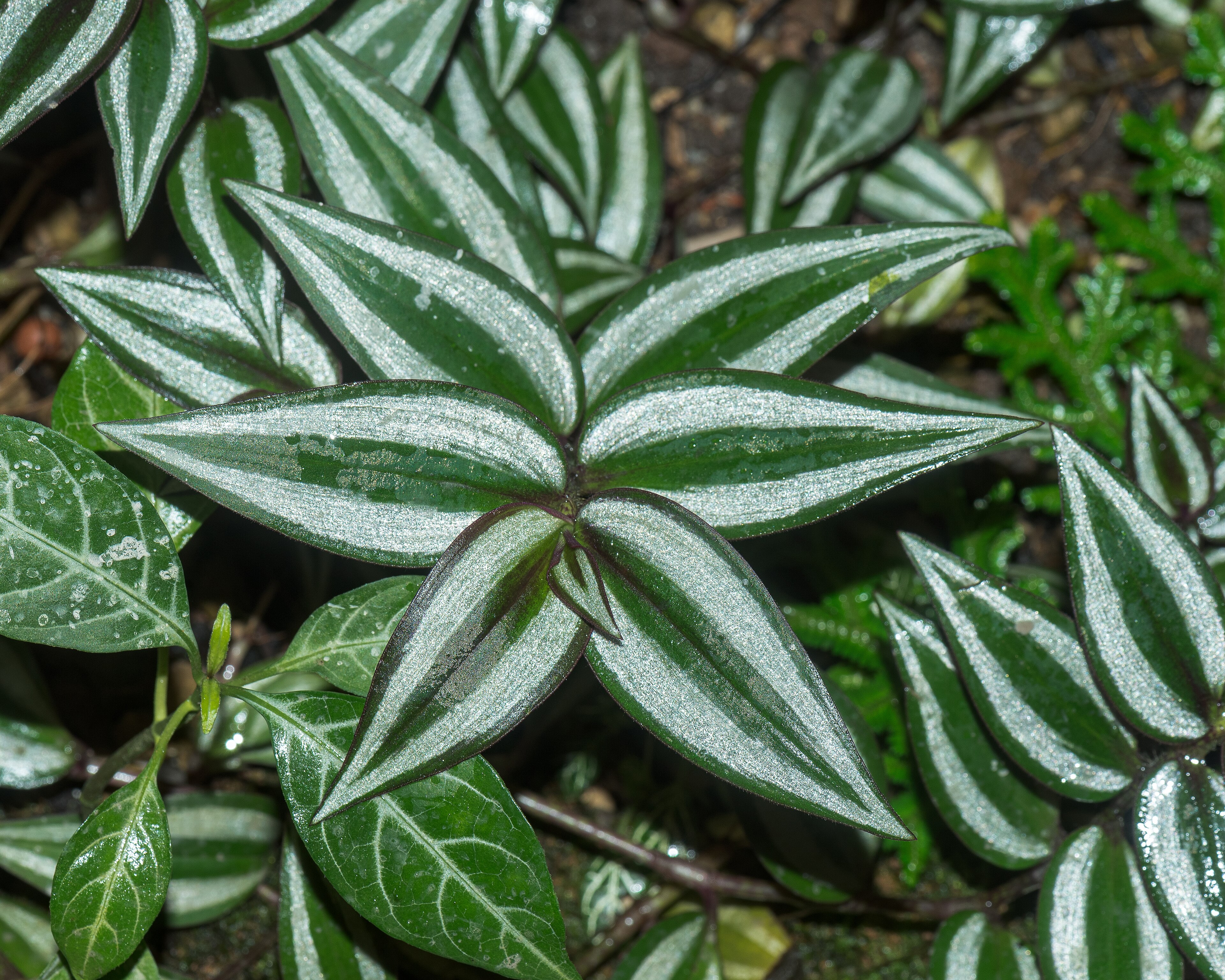
The inch plant. Ultra-fast growing trailing plant with silver-purple-green zebra-striped leaves. Mildly toxic to cats and dogs. Nearly indestructible.
- Difficulty Easy
- Light Bright indirect
- Watering Once a week
- Toxicity Toxic to cats
© Wikimedia Commons, free license (Flocci Nivis, CC BY 4.0)
Family
Commelinaceae
Origin
Mexico, Central America (from southern Mexico to Guatemala)
- easy
- fast growing
- trailing
- hanging plant
- decorative foliage
- variegated
The inch plant
Tradescantia zebrina, best known as the inch plant, wandering dude or silver inch plant, is one of the most spectacular and easiest indoor plants to grow. Its leaves striped with purple, silver, and green create a stunning visual effect that few other plants match. Its growth is so fast that a simple cutting becomes a full plant in a few months, and its care is so permissive that it forgives almost any neglect.
Native to the humid forests of southern Mexico and Central America, Tradescantia zebrina grows naturally as a groundcover plant on forest floors or as a creeping epiphyte on rocks and low trunks. This dual adaptation gives it great ecological tolerance: it accepts both bright light and partial shade, humidity and moderate dry periods.
The species belongs to the Tradescantia genus (Commelinaceae family), named in honor of John Tradescant the Elder, head gardener to King Charles I of England in the 17th century. The genus includes about sixty species, of which zebrina is the most colorful. It was long classified in a separate genus Zebrina pendula, before being attached to Tradescantia by modern taxonomy.
The naming trap
The English name “wandering Jew” is now widely avoided for cultural sensitivity reasons, in favor of “inch plant” (referring to its fast growth, roughly an inch per day in summer) or “spiderwort”. The French name “misère” (misery) is similarly misleading: it does not designate a sick or miserable plant, but comes from a historical confusion with another modest plant of the same nickname. Tradescantia zebrina is in fact anything but sad: it is a burst of colors and growth that can cause aesthetic damage by its very vigor.
The visual signature: purple stripes
The most recognizable visual trait of Tradescantia zebrina is its leaves with two silvery bands on top, on a dark almost purple green background, with an intense purple underside. This unique combination makes it such a sought-after plant for hanging baskets and compositions.
But beware: these colors are not guaranteed. They depend on three precise conditions:
- Bright light: this is factor number one. In too low light, silvery stripes fade and purple undersides turn pale green.
- Specific variety: there are several cultivars (zebrina pure, Quadricolor, Burgundy, Discolor, Purpusii) with different palettes.
- Leaf stage: young leaves are often more colorful than older ones.
See the full guide Tradescantia zebrina losing color for diagnosis and recovery solutions.
Growth: the fastest in your home
Tradescantia zebrina is probably the fastest-growing indoor plant on the market. In good conditions, it can produce several centimeters of stem per week in spring and summer. A simple 5 cm cutting becomes a full plant of 50 cm in 3-4 months.
This speed has two important practical consequences.
Advantage: the plant is very tolerant of pruning. You can cut without hesitation to shape, encourage branching, or take cuttings to give away. It regrows within weeks.
Disadvantage: stems tend to become bare at the base with age. Old leaves fall, new ones only grow at the tips, and the plant takes on a “ponytail” silhouette with bare stems and a tuft of leaves at the end. See tradescantia zebrina bare stems for the solution.
Varieties to know
Tradescantia zebrina standard: the classic form, silvery stripes and purple undersides.
Tradescantia zebrina Quadricolor: more marked variegation with addition of pink and white. Magnificent but more demanding in light.
Tradescantia zebrina Burgundy: darker and more purple colors, more dramatic contrast.
Tradescantia zebrina Discolor (Purpusii): more uniformly purple leaves, without the silvery stripes, sometimes sold as separate cultivar.
Tradescantia zebrina Tikal: newer variety with wider stripes and almost black-purple underside.
All follow the same care, with increased light demand for the most variegated varieties.
Light, watering, substrate
Light. Bright indirect with 2-4 hours of gentle direct sun ideal. Position in front of east, west or south window with sheer curtain. In too low light (more than 1 m from a window, pure north exposure), the plant survives but loses its colors: silvery stripes fade, purple undersides turn pale green, internodes lengthen and the plant becomes spindly.
Watering. Every 5 to 7 days in summer, every 10 to 14 days in winter. Tradescantia zebrina likes consistently slightly moist substrate without being waterlogged. It is one of the few apartment plants that poorly tolerates complete drying: leaves soften and fall. Conversely, prolonged excess water rots roots and stems.
Humidity. 40 to 60 percent is enough. Perfectly tolerates dry apartment air, unlike Calathea or Maranta.
Substrate. Light universal mix with drainage. Recommended mix: 70% green plant potting soil + 20% perlite + 10% vermiculite or peat. Pot with drainage mandatory.
Temperature. 18 to 26 degrees Celsius ideal. Tolerates 12 to 30 degrees. Sensitive to cold below 10 degrees (yellowing, leaf drop).
Fertilizer. Every 2 weeks from April to September, universal fertilizer at half dose. Fast growth consumes a lot. In winter, suspend.
Propagation: the easiest plant to root
Tradescantia zebrina is probably the easiest plant to propagate of all indoor plants. Success rate close to 100 percent.
Water method (ideal for beginners):
- Cut a stem 8-15 cm just below a node
- Remove leaves from the lower third
- Place in a glass of water, bare part submerged
- Visible roots in 3-7 days
- Transplant to soil when roots are 3-5 cm
- Mature plant in 6-8 weeks
Direct soil method: push the cutting without even putting in water first, into moist substrate. Roots in 10-15 days. Slightly lower success rate (80-90 percent) but much faster.
Tip: for a quickly bushy plant, plant 5-7 cuttings simultaneously in the same pot. Instant jungle effect.
Toxicity: precautions to know
Unlike many very popular hanging plants (Hoya, Ceropegia), Tradescantia zebrina is mildly toxic to cats and dogs according to the ASPCA.
For cats: can cause contact dermatitis (skin irritation) and mild digestive disorders if ingested. See Tradescantia zebrina toxic to cats.
For dogs: similar effects. See Tradescantia zebrina toxic to dogs.
For humans: sap can irritate sensitive skin on contact, especially during repeated cuttings. Wear gloves for sensitive skin.
General precautions: keep out of reach of cats and dogs, especially young exploratory animals. The plant lends itself well to height placement (hanging, shelf) which naturally protects it.
Common symptoms to watch
| Symptom | Probable cause | Solution |
|---|---|---|
| Green leaves instead of purple | Insufficient light | Reposition in bright light |
| Yellow leaves at bottom | Aging or overwatering | Space out watering, prune |
| Bare stems at base | Natural untrimmed growth | Pinch heads, propagate in pot |
| Soft drooping leaves | Underwatering | Water, monitor substrate |
| Spindly growth, long internodes | Chronic lack of light | Reposition durably |
| Stem rot | Excess water, confined air | Prune, ventilate, repot |
| Mealybugs | Water stress, stressed plant | Alcohol + black soap |
Common problems and how Spriggo helps
Visual diagnosis is the fastest method to identify a problem on Tradescantia. The Spriggo app lets you photograph the affected area and get a diagnosis in seconds. Discover losing color, yellow leaves, bare stems, watering protocol and mealybug treatment.
Diagnose this plant
-
Diagnosis
Tradescantia zebrina with bare stems: the 3-step solution
Bare stems at the base and a tuft of leaves at the end? This is the universal Tradescantia problem. Complete solution: drastic pruning + mass propagation.
-
Diagnosis
Tradescantia zebrina losing its color: 4 causes and solutions
Silvery stripes fading, purple undersides turning green? The diagnosis is almost always insufficient light. Complete recovery protocol.
-
Disease
Mealybugs on Tradescantia zebrina: identification and treatment
Mealybugs on Tradescantia zebrina: why this plant is vulnerable, visual identification, complete 4-week treatment.
-
Toxicity
Tradescantia zebrina and cats: TOXIC, precautions to know
Tradescantia zebrina listed TOXIC for cats by the ASPCA. Contact dermatitis, digestive irritation. Strict precautions and what to do in case of ingestion.
-
Care
Watering a Tradescantia zebrina: precise protocol by season
Tradescantia zebrina: every 5-7 days in summer, 10-14 days in winter. Substrate consistently slightly moist. Method, water, frequency and mistakes.
-
Toxicity
Tradescantia zebrina and dogs: TOXIC, precautions to know
Tradescantia zebrina listed TOXIC for dogs by the ASPCA. Contact dermatitis, digestive irritation. Strict precautions and what to do in case of ingestion.
-
Diagnosis
Tradescantia zebrina yellow leaves: 5 causes and solutions
Yellow leaves on Tradescantia zebrina: overwatering, natural aging, underwatering, thermal shock, deficiency. Exact diagnostic and recovery.