
Marantaceae
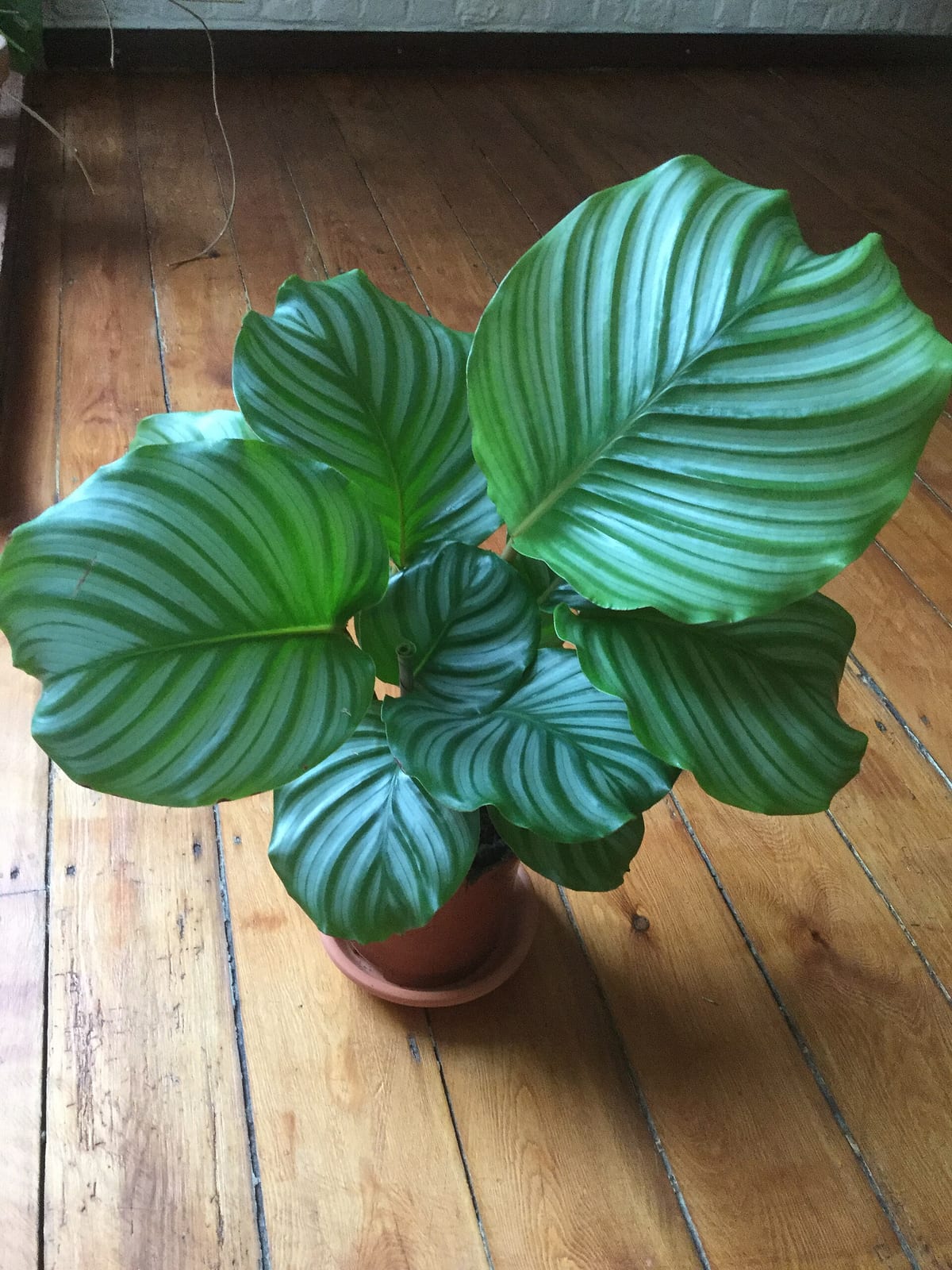
Calathea orbifolia
Goeppertia orbifolia
Queen of the Marantaceae, Calathea orbifolia charms with its wide round leaves striped in silver. Demanding on humidity, it rewards careful owners.
- Difficulty Demanding
- Light Indirect
- Watering Once a week
- Toxicity No known hazard
© Fregisseur, CC BY-SA 4.0
Family
Marantaceae
Origin
Tropical forests of Bolivia
- tropical
- houseplant
- decorative foliage
- demanding
- non toxic
- high humidity
A plant that prays every night
The Calathea orbifolia, scientifically reclassified as Goeppertia orbifolia in 2012, belongs to the Marantaceae family, nicknamed prayer plants. The nickname comes from a spectacular nighttime behavior: the leaves rise upwards at sunset, like hands joined in prayer, then flatten back the following morning. This movement, called nyctinasty, is caused by pressure changes in a specialized joint at the base of the leaf called the pulvinus.
Native to the tropical forests of Bolivia, in the dense shade of the canopy, the Calathea orbifolia adapted to a very specific environment: filtered light, constant atmospheric humidity above 60 percent, stable temperatures between 18 and 27 degrees Celsius. This is precisely what makes the species so demanding inside an apartment, where dry heated air and drafts are the norm.
Its silhouette is immediately recognizable: round leaves, almost circular, reaching up to 30 centimeters in diameter, light green striped with bands of dark green and silver radiating from the central vein. The underside of the leaf is pinkish-purple. It is the most photographed houseplant in its family, ahead of the Calathea medallion and Calathea ornata.
Why it is complicated
Three characteristics explain why the Calathea orbifolia intimidates beginners. First, humidity. Below 50 percent ambient humidity, the tips brown within weeks and the edges curl. In a Paris apartment heated in winter, you easily drop to 30 percent. Second, water quality. Limestone and chlorine from tap water cause brown spots on the leaves. Third, the substrate. A standard garden center potting mix is too dense, water stagnates, roots rot.
The good news: these three constraints are workable. A humidifier in the room, rainwater or filtered water, and an airy substrate based on coconut fiber and perlite are enough to grow a magnificent Calathea orbifolia for years.
Varieties to know
The genus Calathea counts more than 60 species cultivated indoors. You should distinguish the Calathea orbifolia from its popular cousins often confused with it.
Calathea orbifolia: round leaves, silver and dark green stripes, fan-shaped spreading habit, up to 60 centimeters tall.
Calathea medallion (Calathea roseopicta ‘Medallion’): oval leaves with a green and cream medallion pattern, purple underside. More compact habit.
Calathea ornata (Calathea Pin Stripe): oblong leaves, bright pink stripes on dark green background. The most colorful variety in the family.
Calathea lancifolia or Calathea insignis (rattlesnake plant): long narrow leaves, dark green pattern on light green background. The most tolerant for beginners.
Calathea zebrina: velvety deep green leaves with light green stripes. Upright habit.
All share the same humidity requirement. The Calathea orbifolia is considered the most beautiful but also the most temperamental.
Light, watering, substrate
Light. Indirect, never direct. An east or northeast window is perfect. At 1 or 2 meters from a south window with a sheer curtain, ideal. Direct sun fades the patterns and burns the leaves within hours. Conversely, light that is too low slows growth and dulls the silver stripes. If the plant stops producing new leaves during the growing season, it is often a lack of light.
Watering. When the top centimeter of substrate is dry to the touch, roughly every 5 to 7 days in summer, every 10 to 14 days in winter. The substrate should remain slightly moist at all times, never soaked, never completely dry. Use rainwater or filtered water at room temperature, never hard tap water. Cold tap water causes a thermal shock that translates into brown spots within days.
Substrate. Aerated and well-draining mix. The recipe that works: 50 percent special houseplant potting mix, 30 percent coconut fiber, 20 percent perlite. The pH should be slightly acidic to neutral, between 6 and 7. Avoid potting mixes weighed down with too much peat.
Atmospheric humidity. This is the critical point. Minimum 60 percent. Ideal 70 to 80 percent. Solutions in order of effectiveness: electric humidifier in the room (the most reliable), grouping several plants together to create a humid microclimate, saucer with pebbles and water under the pot, misting leaves every 1 to 2 days. A bathroom with a window is an ideal location if there is enough light.
Temperature. Between 18 and 27 degrees Celsius. Never below 15 degrees in winter. No drafts, especially near an entrance door or a poorly insulated window.
Growth and repotting
The Calathea orbifolia produces 3 to 6 new leaves per year in good conditions. Growth is faster from April to September. An adult plant reaches 60 centimeters in height and as much in spread.
Repotting every 2 to 3 years, in spring. Choose a pot just 2 centimeters wider than the previous one. Calathea prefer a slightly snug pot that keeps the substrate moist. Always terracotta or plastic with drainage holes, never a closed pot.
Propagation
The only method that works on Calathea orbifolia is division of the clump. At repotting time, remove the root ball from the pot, identify lateral offsets that have their own roots, gently separate by hand or with a disinfected knife. Repot each section in its own pot. Ideal period: spring. Leaf or stem cutting does not work on this species.
Common symptoms to watch
| Symptom | Likely cause | Solution |
|---|---|---|
| Brown tips | Air too dry, tap water | Humidifier, filtered water |
| Curled edges | Lack of water, direct sun | Water, move to indirect light |
| Yellow leaves | Excess water, drowning roots | Space out, check drainage |
| Soft brown spots | Fungus (excess humidity on foliage) | Ventilate, remove affected leaves |
| Faded leaves | Direct or excessive light | Move back from window |
| Stalled growth | Lack of light or nutrients | Reposition, fertilize in spring |
For each specific symptom, see the detailed guides in the Diagnose this plant section at the bottom of the page.
A plant that is not toxic to cats and dogs
All Calathea, and more broadly the Marantaceae family, are classified non-toxic to cats, dogs, and humans by the ASPCA (American Society for the Prevention of Cruelty to Animals) and the Pet Poison Helpline. This is a major argument for households with pets. If your cat nibbles a Calathea leaf, no poisoning is expected. At worst, mild digestive irritation if massive ingestion, like any unusual plant matter.
It is one of the few large decorative tropical families to offer this complete safety, alongside Pilea, Maranta, and Peperomia.
Diagnose this plant
-
Diagnosis
Calathea orbifolia with brown tips: 4 causes and the real one
Brown tips on Calathea orbifolia: dry air in 70 percent of cases, hard tap water, fertilizer burn, or thermal shock. Exact diagnosis and action plan.
-
Diagnosis
Calathea orbifolia with curling leaves: 3 causes and action plan
Curling leaves on Calathea orbifolia: lack of water or humidity in 80 percent of cases, direct sun, or thermal shock. Diagnosis and correction within days.
-
Living conditions
Humidity for Calathea orbifolia: why 60 percent minimum
Humidity guide for Calathea orbifolia. Why 60 percent humidity minimum, how to measure it, 5 methods to reach the threshold, ranked by real effectiveness.
-
Disease
Spider mites on Calathea orbifolia: identify, treat, prevent
Spider mites on Calathea orbifolia: pest #1 of the species, fueled by dry air. Identify early signs, treatment in 4 steps, durable prevention.
-
Toxicity
Is Calathea orbifolia toxic to dogs? Veterinary answer
Calathea orbifolia is not toxic to dogs. Classified non-toxic by ASPCA, no oxalates, no saponins. Safety details and behaviors to watch.
-
Toxicity
Is Calathea orbifolia toxic to cats? Veterinary answer
Calathea orbifolia is not toxic to cats. Classified non-toxic by ASPCA, no oxalates, no saponins. Safety details, behaviors to watch, recommended pet-safe plants.
-
Care
How to water a Calathea orbifolia: frequency, water, method
Complete watering guide for Calathea orbifolia. Every 5 to 7 days in summer, lukewarm filtered or rainwater, slightly moist substrate at all times. Mistakes to avoid.
-
Diagnosis
Calathea orbifolia with yellow leaves: 4 causes diagnosed
Yellow leaves on Calathea orbifolia: excess water in 60 percent of cases, lack of light, natural aging, or nutrient deficiency. Identify the cause and stop yellowing.