
Moraceae
Fiddle leaf fig
Ficus lyrata
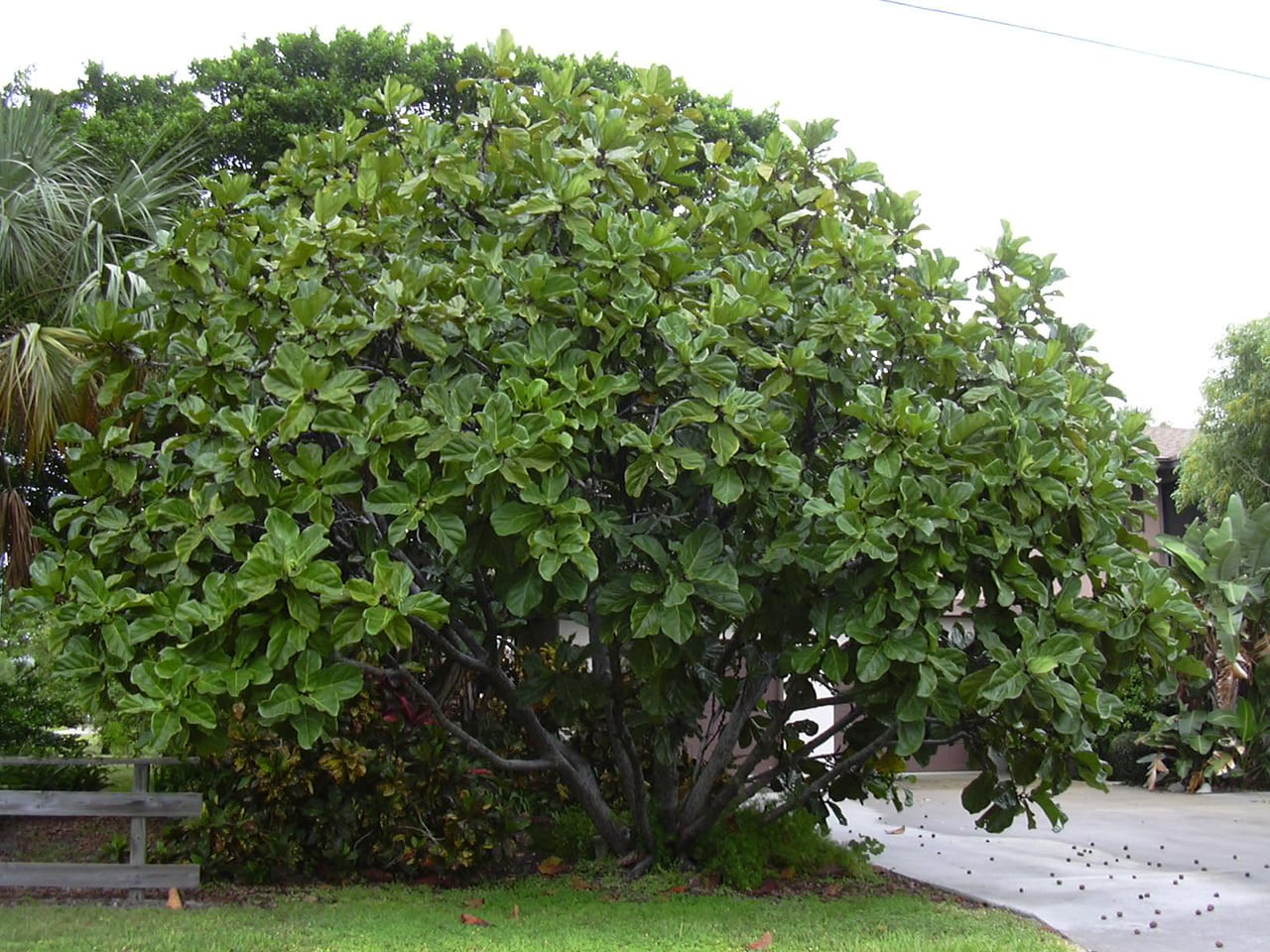
Instagram star and notorious diva, the fiddle leaf fig rewards consistency and punishes improvisation. Bright light, controlled watering, zero draft.
- Difficulty Demanding
- Light Bright indirect
- Watering Once a week
- Toxicity Toxic to cats
© Forest & Kim Starr, CC BY 3.0
Family
Moraceae
Origin
Tropical rainforests of West Africa (Cameroon to Sierra Leone)
- tropical
- houseplant
- indoor tree
- difficult
- decorative foliage
- trendy
An Instagram star with a difficult reputation
The fiddle leaf fig, Ficus lyrata, has become in fifteen years the most photographed indoor tree in the world. Its large violin-shaped leaves, its architectural posture and its silhouette of a small tree have pushed it into every decoration magazine, every Instagram wall, and behind half the LinkedIn profile photos. This popularity has a flip side: it is also the houseplant that most often dies in the first year after purchase. Not because it is fragile, but because its decorative reputation hides a demanding temperament that few garden centers communicate at point of sale.
Native to the tropical rainforests of West Africa, where it grows tall under a diffuse canopy, Ficus lyrata reaches 12 to 15 meters in the wild. Indoors, under good conditions, it can exceed 2 meters in a few years. Its growth is slow but steady: 15 to 30 cm per year for a healthy plant, more in summer. The leaves can reach 30 to 45 cm long on mature specimens, with a leathery texture, deeply marked veins and a waxy glossy green. The characteristic shape, like a lyre or fiddle (hence the English name), comes from an adaptation to capture diffuse light from the forest understory while shedding rainwater through the leaf tip.
Why so many owners fail
The fiddle leaf fig is not more fragile than a Monstera or a Pothos on paper. The problem is that it tolerates no sudden change. It hates moves, temperature swings greater than 5 degrees, drafts and cold water. It takes several weeks to adapt to a new location, and during that adaptation it often drops leaves, which makes the owner panic and change something else, which worsens the stress. This vicious circle kills most plants.
The other classic trap is insufficient light. The fiddle leaf fig is sold as “tolerant of medium light” in many commercial care cards. False. It survives in medium light but does not grow. To grow and produce new leaves, it needs 2 000 to 5 000 lux minimum, meaning placement within 2 meters of an east, west or filtered south window.
Light, watering, substrate
Light is the number one factor. Without enough light, no perfect watering, no fertilizer will save the plant. Ideally, place the fiddle leaf fig near an east or west window with a sheer curtain. A south window without curtain burns the leaves, especially in summer. A north window only works in summer in a very bright room, never in winter. Rotate the plant a quarter turn every 2 to 3 weeks so growth stays balanced. If a grow light is needed, target 20 to 30 W full-spectrum LED at 50 cm above the canopy, 10 to 12 hours per day.
Watering is the second most problematic factor. The fiddle leaf fig hates both too little and too much water. The rule that works best: water when the top 3 to 4 cm of substrate is dry to the touch, never before. In practice, this gives one watering every 7 to 10 days in summer and every 12 to 18 days in winter. Always water generously until water drains from the pot bottom, then empty the saucer 15 minutes later. Standing water in the saucer is the leading cause of root rot. See our dedicated article on fiddle leaf fig watering.
The substrate must drain perfectly while retaining slight moisture. Recommended mix: 50 percent quality houseplant potting mix, 30 percent perlite or pumice, 20 percent pine bark. This structure avoids compaction that suffocates roots. The pot must have drainage holes. A watertight cachepot is never a good idea for a fiddle leaf fig, even if emptied regularly.
For humidity, the fiddle leaf fig prefers 40 to 60 percent ambient humidity. This is generally what you have in a well-ventilated home. In winter with central heating, the air can drop to 20-30 percent and the plant can develop dry leaf edges. A humidifier nearby solves the problem; misting only has a 10-minute effect.
For fertilizer, from spring to autumn, a balanced houseplant fertilizer (NPK 3-1-2 for example) diluted to half dose, every 2 weeks, supports growth. No fertilizer in winter. No fertilization within 4 weeks after a repotting: roots are stressed.
Toxicity for cats, dogs and children
The fiddle leaf fig, like most species in the Ficus genus, contains a white milky latex in all its parts (stems, leaves, roots). This latex is a strong irritant for mucous membranes and sensitive skin. If a cat or dog chews or swallows a piece of leaf, you quickly see drooling, nausea, sometimes vomiting and oral irritation. Repeated contact can also cause dermatitis in animals with sensitive skin. For species-specific information, see our dedicated articles for cats and dogs.
The danger is rarely life-threatening in a healthy adult, but can be in a kitten, puppy or fragile senior animal. If ingestion is suspected, rinse the mouth with fresh water and watch for the following hours. Consult a veterinarian if the animal becomes apathetic, vomits multiple times or if drooling persists more than a few hours.
For children, same precautions. Sap in the eyes can cause irritant conjunctivitis. Always wear gloves to prune or take cuttings if your skin is sensitive.
The most common problems
The fiddle leaf fig develops four typical problems that every owner encounters sooner or later. Learning to tell them apart changes everything.
Yellow leaves almost always signal overwatering or prolonged insufficient light. The exact diagnosis depends on which leaves yellow (low or high, isolated or grouped). Our complete guide on fiddle leaf fig yellow leaves details the five possible causes in order of probability.
Brown spots, particularly feared by owners, have very varied causes: excess water, drought, sunburn, temperature shock, even bacterial disease in advanced cases. Spot shape and location give the main clue. Details in our brown spots article.
Sudden leaf drop is the most dramatic stress symptom. A plant can lose several leaves in a few days after a move, a cold draft or a strong temperature swing. See fiddle leaf fig dropping leaves for the emergency protocol.
For pests, the fiddle leaf fig is sensitive to mealybugs (white cottony clumps in leaf axils and on young shoots) and spider mites (fine webs and pale spots on leaves, especially in winter with heating). Monthly inspection is mandatory, neem oil or insecticidal soap at the first sign.
When in doubt, the photo decides
Several fiddle leaf fig symptoms look alike: yellow leaves from too much water or insufficient light, brown spots from drought or temperature shock, leaf drop from stress or disease. Changing several parameters at once is the best way to worsen the situation without understanding it. The Spriggo app analyzes a photo of your plant and identifies the predominant cause in seconds, with an adapted action plan. Particularly useful on this species where cross-diagnoses are frequent.
Diagnose this plant
-
Disease
Fiddle leaf fig bacterial infection (Xanthomonas): identify and rescue
Black spots with yellow halo spreading: this is Xanthomonas bacterial infection, feared by fiddle leaf fig owners. Diagnosis, treatment, real hope.
-
Diagnosis
My fiddle leaf fig is dropping leaves: what to do by cause
The fiddle leaf fig is famous for sudden leaf drop. Here are the 4 main causes, their signatures and the emergency protocol for each case.
-
Disease
Mealybugs on fiddle leaf fig: complete treatment
The fiddle leaf fig is very sensitive to mealybugs, especially in winter. Precise identification, treatment protocol and prevention.
-
Diagnosis
Fiddle leaf fig brown spots: identify the real cause
Brown edges, brown centers, isolated spots: the shape of brown spots on a fiddle leaf fig reveals the exact cause. Method and fixes.
-
Toxicity
Is the fiddle leaf fig toxic to cats?
Yes, the fiddle leaf fig is toxic to cats. Symptoms, real severity, what to do if ingested, and solutions to live peacefully with both.
-
Toxicity
Is the fiddle leaf fig toxic to dogs?
Yes, the fiddle leaf fig is toxic to dogs. Symptoms, severity, what to do if ingested, and solutions to protect your animal.
-
Care
Fiddle leaf fig watering: complete method without rot
Watering is the number one killer of fiddle leaf figs. Here is the precise method, frequency, signals and mistakes to avoid, season by season.
-
Diagnosis
Fiddle leaf fig yellow leaves: 5 causes and the right diagnosis
Yellow leaves on a fiddle leaf fig are never trivial. Overwatering, low light, shock, deficiency: how to identify the real cause in 3 minutes.