
Urticaceae
Pilea
Pilea peperomioides
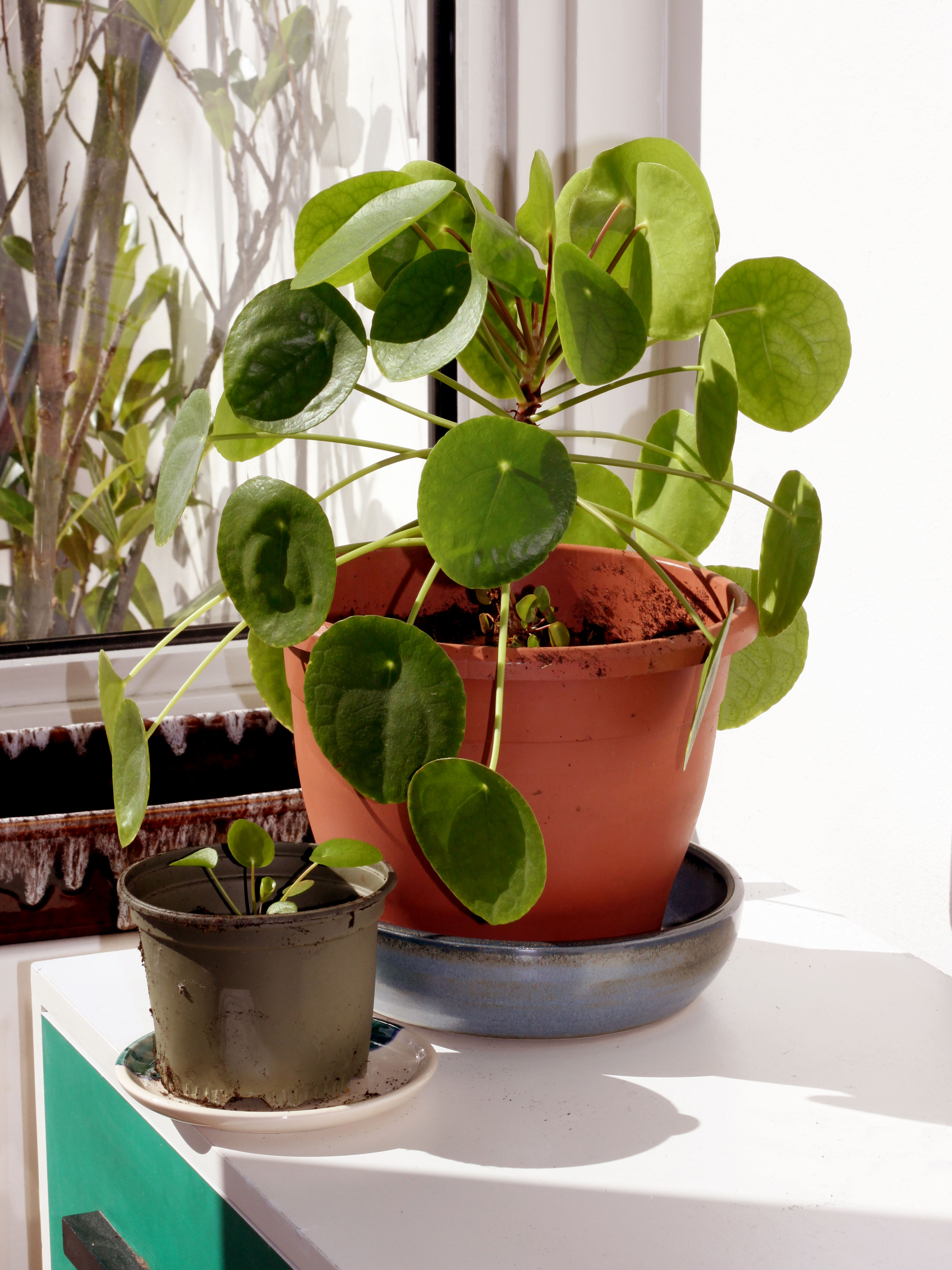
The Chinese money plant. Round coin-shaped leaves, easy propagation through babies, NON-toxic to cats, dogs and humans. Easy indoor plant.
- Difficulty Easy
- Light Bright indirect
- Watering Once a week
- Toxicity No known hazard
© Wikimedia Commons, free license (Husky, CC0)
Family
Urticaceae
Origin
China (Yunnan province, Eastern Himalayas)
- non toxic
- easy
- indoor plant
- round leaves
- easy propagation
- bright light
The Chinese money plant
The Pilea peperomioides, nicknamed Chinese money plant, missionary plant or pancake plant, is one of the most popular houseplants of the 2020s. Its perfectly round leaves resembling coins or pancakes give it a unique graphic look. It broke through on Instagram and Pinterest thanks to its photogenic silhouette and compact growth.
Native to the humid forests of Yunnan, China, on the eastern foothills of the Himalayas, Pilea peperomioides grows wild on shaded rocks at 1500-3000 m altitude. This mountain origin explains its adaptation to moderate temperatures and reasonable atmospheric humidity without extremes. It cannot tolerate prolonged tropical heat or summer direct sun.
The species belongs to genus Pilea (family Urticaceae, like nettle but without stinging hairs) which counts more than 700 tropical and subtropical species. Curiously, peperomioides is one of the few cultivated massively indoors, and remained a botanical rarity for a long time before becoming the star it is today.
The story behind the “missionary plant”
The plant’s introduction to Europe is one of the most charming in the plant world. In 1946, Norwegian missionary Agnar Espegren brought back Pilea peperomioides seedlings from China’s Yunnan province to Norway. He distributed them to family and friends, who multiplied them and offered them around. For 40 years, the plant circulated only through word-of-mouth and propagation between private individuals, without ever being commercialized. It remained totally unknown to Western botanists until the 1980s.
This tradition explains its nickname “missionary plant”. Today still, many Pileas in our homes descend genealogically from Espegren’s original specimens, thanks to this unbroken sharing chain among enthusiasts.
This story also explains why Pilea remains cheaper to obtain secondhand or as a gift than at the garden center: propagation by amateurs is so simple that enthusiasts always have plantlets to give away.
Why Pilea is taking off
Three qualities make Pilea an exceptional houseplant for beginners and enthusiasts alike.
Exceptionally easy propagation. Pilea naturally produces plantlets (babies) at the base of the mother plant or emerging directly from the substrate a few centimeters away. Cleanly cut the baby with a bit of root and replant in another pot, getting a new autonomous plant within weeks. No other common houseplant propagates so simply.
100 percent non-toxic plant. For cats, dogs, humans, children: no toxic compounds. Listed as safe by ASPCA and European veterinary databases. Perfect for families with pets or young children who chew leaves.
Fast visible growth. Pilea regularly puts out new leaves (1 to 2 per week in growing season), giving the gratifying feeling of a plant “that lives”. Ideal for beginners who need fast positive feedback to persevere.
Light, watering, substrate
Light. Bright indirect. Ideal: 1-2 m from an east or west-facing window, or behind a light sheer in front of a south window. Avoid prolonged direct sun which can scorch leaves in summer (whitish or brown spots). In light too low (dark room, more than 3 m from a window), growth stops, leaves tilt toward light, petioles elongate.
Rotating the plant a quarter turn each week is essential: without rotation, the plant tilts so much toward light that it eventually loses balance and graphic look.
Watering. Every 7 to 10 days in summer, every 14 days in winter. Substrate should dry to 2-3 cm at surface between waterings. Water at room temperature. Pilea tolerates light underwatering better than excess water, which causes rapid root rot.
Humidity. Medium sufficient: 40 to 60 percent. Pilea adapts very well to apartment ambient humidity, making it simpler than tropicals (Croton, Calathea, Anthurium) that require 70 percent. In very dry heated winter air, leaf tips may slightly brown: humidifier or grouping with other plants suffices.
Substrate. Light, draining. Ideal mix: 60% green plant soil + 30% perlite + 10% vermiculite. Pot with drainage required (Pilea hates wet feet).
Temperature. 18 to 24 degrees Celsius ideal. Tolerates 10 to 28 degrees. Avoids cold drafts, but much more cold-resistant than true tropicals (Pilea handles 10 degrees without damage, unlike Croton which defoliates below 15 degrees).
Fertilizer. Every 3-4 weeks April to September, green plant fertilizer at half dose. In winter, stop completely.
Propagation: the magic of Pilea
This is the most appreciated characteristic of this plant. Three types of babies naturally appear:
Stem babies: emerge at the base of the main trunk, after a few months. Cut with disinfected cutter just above the root. Replant directly in moist substrate.
Soil babies: emerge from substrate a few centimeters from mother plant, via underground rhizomes. Often the most vigorous. Gently lift substrate, harvest plantlet with its own roots, replant.
Post-bloom babies: rare indoors but possible after spring flowering on mature plant (3+ years).
A mature 2-3 year old Pilea produces 5 to 15 babies per year. Count 2-3 months for a plantlet to become autonomous and 6-12 months to resemble a real adult plant. See full guide Pilea no babies to revive a plant that does not produce.
Growth and care
Growth moderate to fast: 15 to 30 cm per year. Indoor height 25-45 cm. Similar width. Pilea stays compact, perfect for shelves and small spaces.
Repotting every 2 years in spring, pot 2-3 cm wider. Pilea likes to be slightly snug. Too large pot = too much retained moisture = rot risk.
Pruning: not essential. Possible to cut mother plant top to encourage branching (rare, usually we prefer the simple profile). Cut top propagates easily.
Leaf cleaning: damp cloth on leaves once a month. Pilea captures light on its entire round leaf surface, dusting maximizes photosynthesis.
A 100 percent safe houseplant
Pilea peperomioides is one of the rare popular houseplants completely non-toxic for all household inhabitants.
For cats: non-toxic. Listed safe by ASPCA. If your cat chews a leaf, no toxic effect expected, just possibly slight harmless mechanical irritation. See Pilea non-toxic to cats.
For dogs: non-toxic. No dangerous compounds identified. See Pilea non-toxic to dogs.
For humans and children: non-toxic. Even in case of accidental ingestion by young child, no health risk (beyond transient digestive discomfort any plant fragment would cause). No irritating sap (unlike Croton, Euphorbia, Dieffenbachia).
Precautions: none particular. Pilea can be handled without gloves, pruned, propagated, replanted without skin reaction risk. One of the ideal plants for families with young children.
Common symptoms to watch
| Symptom | Likely cause | Solution |
|---|---|---|
| Leaves curled in cup | Light or water stress | Adjust exposure and watering |
| Leaves dropping | Thermal shock or excess water | Stabilize conditions |
| No babies on mature plant | Insufficient light or age | Improve conditions, wait |
| Yellow leaves | Most often excess water | Space out watering |
| Plant leaning to one side | Lack of rotation | Rotate quarter turn weekly |
| Brown tips | Air too dry | Humidifier or grouping |
| Mealybugs | Dry air + isolation | Black soap + alcohol |
Common problems and how Spriggo helps
Visual diagnosis remains the fastest method to identify a problem on Pilea. The Spriggo app lets you photograph the affected area and get a diagnosis within seconds, with corrective actions to take. Discover Pilea curling leaves, dropping leaves, no babies, watering protocol and mealybug treatment.
Diagnose this plant
-
Diagnosis
Pilea dropping leaves: why and how to react
Pilea dropping leaves: 50 percent overwatering, thermal shock, natural aging or transition stress. Fast diagnosis and solutions.
-
Diagnosis
Pilea with curling leaves: 4 causes and solutions
Pilea leaves curling in cup or doming: 50 percent excess light, underwatering, thermal shock or humidity variation. Diagnosis and solutions.
-
Disease
Mealybugs on Pilea: identify and treat quickly
Pilea mealybugs: identify cottony white clusters, alcohol 70 + black soap treatment, complete protocol in 3 weeks.
-
Care
Pilea no babies: why and how to trigger propagation
Pilea not producing babies: insufficient age, low light, oversized pot, stress. Diagnosis and optimal conditions to restart plantlet production.
-
Toxicity
Is Pilea toxic to cats? No, it is safe
Pilea peperomioides and cats: NON-toxic. Listed safe by ASPCA. Confirmed safety for households with cats. Precautions and alternatives.
-
Toxicity
Is Pilea toxic to dogs? No, safe plant
Pilea peperomioides and dogs: NON-toxic. Listed safe by ASPCA. Confirmed safety for households with dogs. Minor precautions.
-
Care
How to water a Pilea: frequency, method, mistakes
Pilea watering: every 7-10 days in summer, every 14 days in winter. Substrate dried at surface between waterings. Room-temperature water.