
Asparagaceae
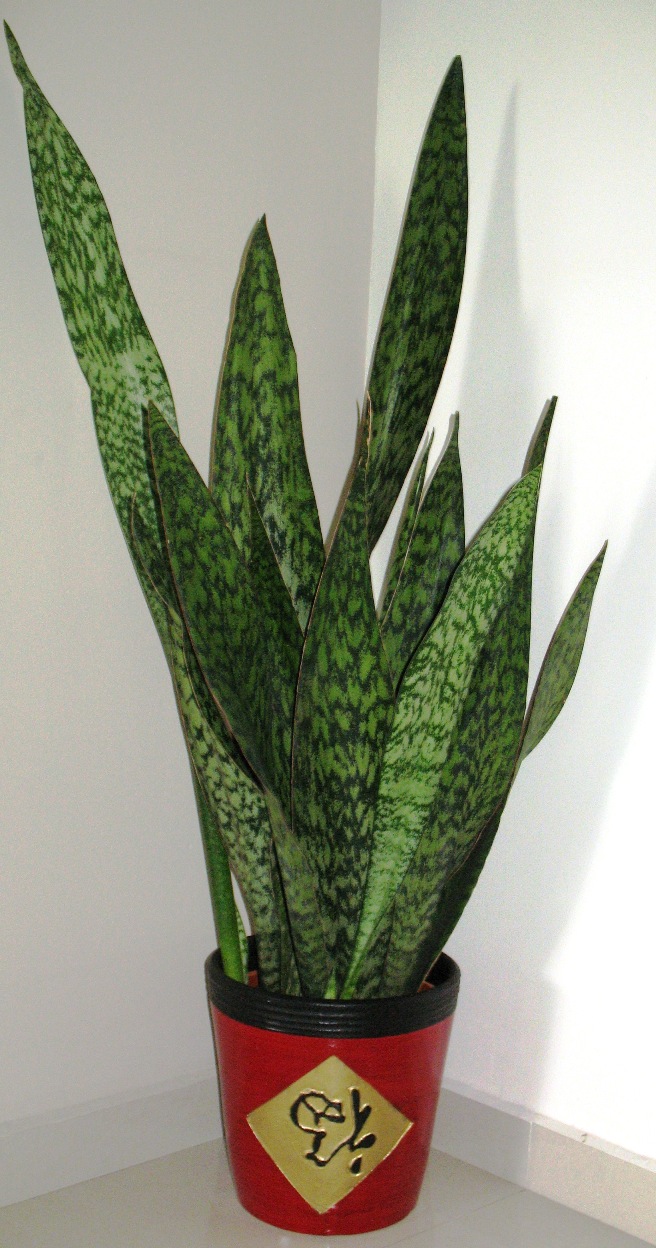
Snake plant
Dracaena trifasciata
The indestructible houseplant par excellence. Tolerates missed watering, low light, dry air. Only real enemy: too much water.
- Difficulty Easy
- Light Indirect
- Watering Sparse
- Toxicity Toxic to cats
© Wikimedia Commons, CC BY-SA
Family
Asparagaceae
Origin
Tropical West Africa, from Nigeria to Congo
- succulent
- houseplant
- easy
- graphic foliage
- air purifying
- tolerant
The (almost) indestructible plant
The snake plant, long called Sansevieria trifasciata then reclassified as Dracaena trifasciata in 2017, has the justified reputation of being one of the most tolerant houseplants in the world. Native to the savannas and dry forests of tropical West Africa, it evolved to survive prolonged dry seasons by storing water in its fleshy leaves. This adaptation explains its ability to withstand missed waterings of several weeks, low light, and very dry apartment air.
Its graphic silhouette of upright marbled green sword-like leaves has been iconic of interior design since the 1970s. Mid-century, law office, Scandinavian living room: you encounter it everywhere, because it survives anything, and stays beautiful even without care.
The nickname snake plant comes from the patterns of light and dark bands that recall snake skin. The nickname mother-in-law’s tongue comes from the long pointed shape of the leaves. Both designate the same plant, but depending on varieties (laurentii, hahnii, moonshine, cylindrica), appearance varies considerably.
Why so many people still kill it
Paradoxically, the indestructible snake plant is one of the plants beginners kill most often. The reason: overwatering. Used to watering their plants “once a week” or “when the potting mix is dry on the surface”, snake plant owners drown it without knowing. Root rot follows in a few weeks, leaves become soft at the base, and the plant literally collapses.
Good news: just water less for it to rebound. A snake plant that has lost 50 percent of its leaves can rebuild in 6-12 months if you give it just what it needs.
Other typical problems (insufficient light, cold draft) are rare and much less serious. The snake plant forgives everything except overwatering.
Varieties to know
Several cultivars exist, with identical behaviors but very different appearances.
Laurentii: the classic variety, with medium green leaves marbled and yellow-edged. Most widespread, medium growth.
Hahnii or bird’s nest: compact rosette variety, 15-20 cm, ideal for small pot. Slower.
Moonshine: very light silvery-green leaves. Moderate light needed to keep the color.
Black gold: very dark green almost black leaves with yellow-gold edges. Very decorative.
Cylindrica: round cylindrical leaves rather than flat. Same needs, different graphic look.
Whitney: variegated green and cream, slow.
All grow identically. Choice is purely aesthetic.
Light, watering, substrate
Light: the snake plant tolerates a wide range, this is its strength. Ideal: bright indirect (near east or west window with sheer curtain), it grows fast and produces new shoots regularly. Acceptable: medium light (2-3 meters from a window), slow growth but health maintained. Limit: prolonged low light (dark hallway, deep north room), it survives but no longer grows. Avoid: prolonged direct sun that can bleach leaves, especially in summer.
Watering is the only critical factor. Golden rule: water only when substrate is totally dry in depth. Not just on surface, not at mid-pot, but entirely dry. In practice, this gives one watering every 14 to 21 days in summer and every 4 to 6 weeks in winter in a heated apartment. Rarer than all other houseplants. See our detailed watering guide for the complete method.
The substrate must drain extremely well. Recommended mix: 40 percent houseplant potting mix, 30 percent perlite or pumice, 30 percent coarse sand or pine bark. Commercial “cactus and succulent” mix also works. Drainage holes mandatory. A watertight cachepot is absolutely forbidden.
For humidity, the snake plant tolerates 20-50 percent without issue. No humidifier needed, unlike many tropical plants.
Fertilizer only from March to August, diluted to a third dose, every 4-6 weeks. Nothing in winter, nothing in the 6 weeks following a repot.
Toxicity for cats, dogs and children
The snake plant contains saponins in all its parts. These compounds are “natural detergents” that irritate the digestive mucous membranes. Ingestion by a cat or dog: heavy drooling, vomiting, sometimes diarrhea. Details in our dedicated articles toxicity for cats and toxicity for dogs.
Rarely vital in an adult, but uncomfortable. More at risk in kittens and puppies.
For children, same precautions. Sap can irritate sensitive skin. Always wear gloves to propagate or divide.
Common problems
The snake plant being tolerant, its problems boil down to a few scenarios:
Soft or falling leaves: almost always overwatering. Root rot is underway. See snake plant soft leaves.
Yellow leaves: overwatering (most often), but sometimes too much direct sun or deficiency. See our yellow leaves guide.
Rotting at leaf base: leaves collapsing at the base and detaching. Emergency signal of advanced root rot. See base rot.
Mealybugs: rare but possible in winter in axils. See our snake plant mealybugs article.
When in doubt, the photo decides
The Spriggo app identifies root rot, soft leaves, mealybugs from a photo. Particularly useful on this species where the diagnosis plays out between “needs water” (rarely) and “let dry” (often), opposite choice depending on the exact symptom.
Diagnose this plant
-
Diagnosis
Snake plant rotting at the base: urgent rescue
Leaves detaching at the base and falling? It is advanced root rot. Here is the emergency protocol to save what remains.
-
Disease
Mealybugs on snake plant: complete treatment
Rare but possible, mealybugs on snake plants appear in leaf axils. Identification, treatment, prevention.
-
Diagnosis
Snake plant soft leaves: root rot underway
Leaves becoming soft or falling sideways almost always signal root rot. 4-step rescue protocol.
-
Toxicity
Is the snake plant toxic to cats?
Yes, the snake plant is toxic to cats due to its saponins. Moderate severity. Symptoms, actions, solutions to coexist.
-
Toxicity
Is the snake plant toxic to dogs?
Yes, the snake plant is toxic to dogs due to its saponins. Moderate risk. Symptoms, actions, and solutions to protect your dog.
-
Care
Snake plant watering: the golden rule
The snake plant prefers to lack water than to have too much. Complete method, frequency, signals and mistakes to avoid to keep it alive.
-
Diagnosis
Snake plant yellow leaves: 5 causes and diagnosis
Overwatering in 80 percent of cases. Here is how to identify the real cause of yellow leaves on your snake plant and fix it in a few weeks.