
Asparagaceae
Spineless yucca
Yucca elephantipes
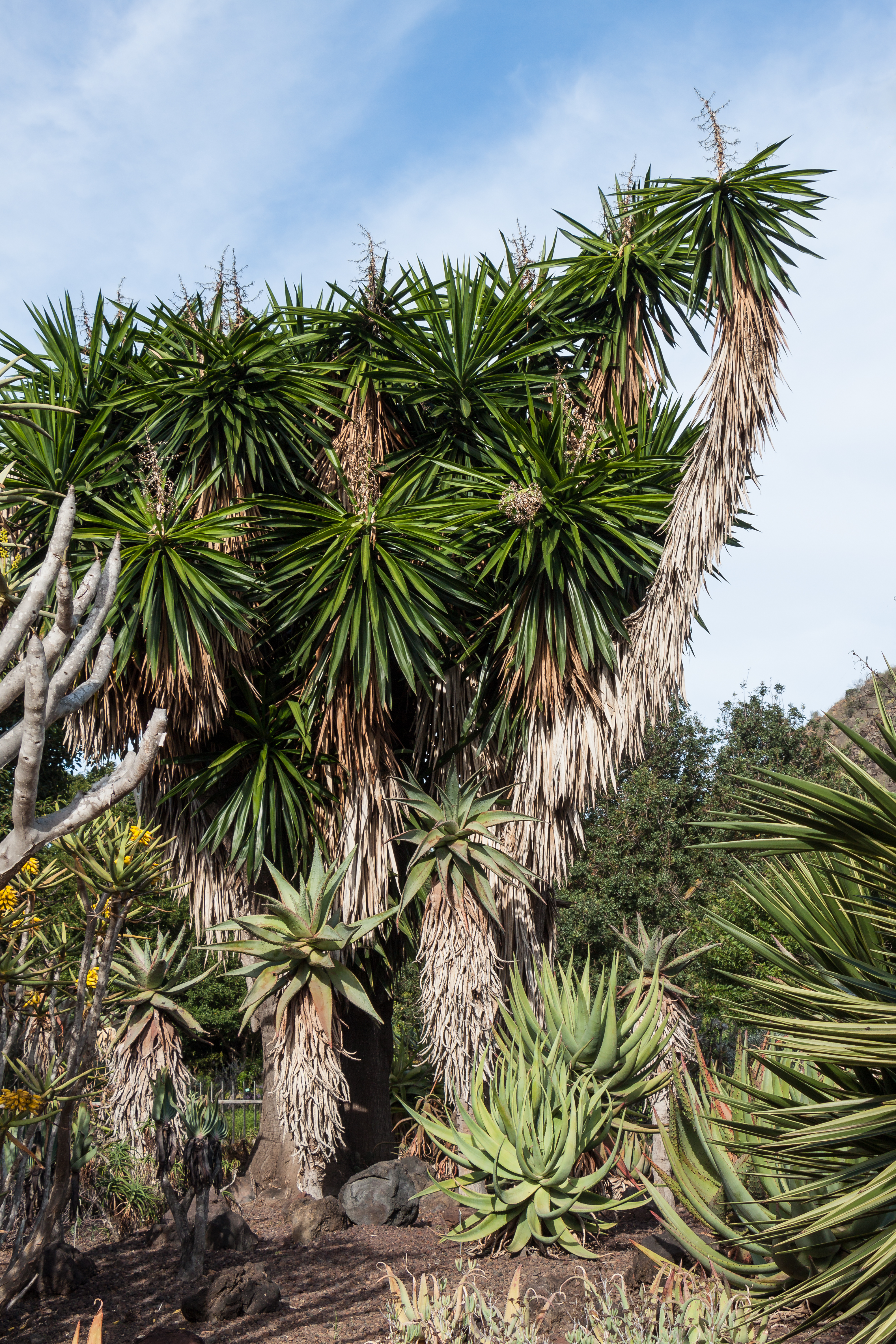
The spineless yucca with an elephant foot trunk. Desert plant tolerating bright direct light and rare watering. Toxic to cats and dogs (saponins).
- Difficulty Easy
- Light Bright indirect
- Watering Sparse
- Toxicity Toxic to cats
© Wikimedia Commons, free license (H. Zell, CC BY-SA 3.0)
Family
Asparagaceae
Origin
Arid regions of Mexico and Guatemala
- desert
- houseplant
- easy
- bright light
- tolerant
- architectural
The spineless yucca with elephant foot trunk
The Yucca elephantipes (synonyms Yucca gigantea, Yucca guatemalensis), commonly called spineless yucca, giant yucca or soft-tip yucca, is one of the most recognizable architectural houseplants. Its thick light gray woody trunk carries one or several rosettes of long narrow bright green leaves arranged like pompoms on top.
Native to the arid regions of Mexico and Guatemala, this yucca grows naturally on rocky and dry land in full sun. It has evolved to store water in its fleshy trunk (hence the swollen base resembling an elephant foot) and survive long periods without rain. This origin dictates its indoor care: bright direct light, rare watering, very draining substrate.
The qualifier elephantipes comes from Latin and means “elephant foot” referring to the flared base of the trunk. This unique silhouette makes the yucca a prized sculptural decorative plant for minimalist interiors, offices, and verandas.
Why “spineless”
Although bearing the yucca name, Yucca elephantipes differs from other yuccas by a major particularity: its leaves are not prickly at the tip. True desert yuccas (Yucca aloifolia, Yucca filamentosa, Yucca rostrata) have leaf tips as sharp as needles, dangerous for eyes and children. The elephantipes has soft leaves with a thin brown tip but not pricky.
It is this characteristic that makes it suitable for indoor cultivation while other yuccas remain primarily outdoor plants in mild climates. In English it is often called spineless yucca.
Botanical distinction: since recent taxonomic revisions, Yucca elephantipes, Yucca gigantea and Yucca guatemalensis are recognized as the same species. Nurseries use these three names interchangeably.
Why so many people choose it
Three characteristics explain its lasting success indoors.
Architectural and sculptural. The contrast between the thick gray trunk and the green tuft on top creates an immediate graphic silhouette. A mature 1.50 m yucca in a large pot transforms a room like no other houseplant.
Very tolerant and easy. Probably the most tolerant houseplant after the sansevieria. Survives missed waterings (several weeks no problem), adapts to different temperatures, resists drafts. Ideal for beginners or travelers.
Slow growth, long lifespan. A yucca grows only 5 to 15 cm per year. Once bought at 1 m, it will stay this size for years. No surprise like with a ficus or philodendron that can double in two years. Indoor lifespan: 15 to 30 years, or more.
Light, watering, substrate
Light. Bright direct or intense indirect. Ideal: in front of a south, west or east facing window, without curtain. The yucca can take several hours of direct sun per day without issue, it is even recommended. In a dark room it stretches, leaves become soft, the trunk weakens and the plant slowly dies (in 1 to 2 years).
Watering. Every 12 to 15 days in summer, every 30 to 40 days in winter. Substrate must dry completely between waterings (check 5 cm deep with a finger). The most common mistake: overwatering. The yucca prefers drought to excess water. Its roots rot and its trunk softens within weeks of too frequent watering.
Substrate. VERY draining, cactus mix. Ideal mix: 50% cactus potting soil + 30% perlite or pumice + 20% river sand. Pot with drainage mandatory. Classic mistake: universal substrate too dense → water stagnates → soft trunk → death.
Humidity. LOW tolerated (30-50%). Unlike tropicals (Anthurium, Calathea), the yucca likes the dry indoor air of heated apartments. No need for misting, no need for humidifier. Ideal for modern low-humidity interiors.
Temperature. 15 to 28 degrees ideal. Tolerates 5 to 35 degrees. No frost (below 0 = certain death in indoor culture). Tolerates air conditioning perfectly.
Fertilizer. Every 6 to 8 weeks from April to September, cactus fertilizer at half dose. Not essential, the yucca grows slowly with few nutrients. In winter, stop completely.
Growth and maintenance
Growth very slow: 5 to 15 cm height per year. Indoor height 1 to 3 m over 10 to 20 years. In the wild, Yucca elephantipes can reach 8 to 10 m tall but in a pot the evolution is very contained.
Repotting every 3 to 5 years only, in spring. The yucca likes being a bit cramped in its pot. Choose a pot 3-4 cm wider. Draining cactus substrate essential.
Leaf cleaning: wipe a damp cloth over the leaves every 2-3 months to remove dust (shiny leaves capture light better).
Cut damaged leaves: brown or dry leaves at the bottom are cut at the base with clean pruning shears. Never cut a healthy green leaf.
Propagation: by trunk cutting. Cut a 20-30 cm trunk segment, let callus for 1 week in open air, plant in moist substrate. Roots in 4-8 weeks. Or harvest the lateral offshoots that sometimes appear at the base of a mature yucca.
Common symptoms to watch for
| Symptom | Likely cause | Solution |
|---|---|---|
| Yellow leaves | Excess water or lack of light | Space watering, reposition |
| Brown tips | Air dryness or limestone water | Filtered water, cut tips |
| Soft or mushy trunk | Rot (excess water) | EMERGENCY repotting |
| Drooping leaves | Lack of light | Reposition near window |
| Curled leaves | Sun too direct (rare case) | Light curtain in summer |
| Mealybugs | Dry air + isolation | Black soap + alcohol |
A plant toxic to pets
Unlike the Araceae (Anthurium, Spathiphyllum) that use calcium oxalates, Yucca elephantipes contains steroidal saponins in all its parts. Ingestion by cat or dog causes:
- Vomiting
- Excessive salivation
- Diarrhea sometimes
- Moderate lethargy
Mortality rare. Symptoms typically resolved in 24 to 48 hours. More uncomfortable than dangerous but veterinary consultation recommended if persistent symptoms. See Yucca toxic to cats and to dogs.
Additional risk: the long thin leaves can cause eye injuries if a cat jumps nearby or gets its eyes caught in the rosette. Place the yucca so the leaves are not at cat head height (in height or away from jump zones).
Common problems and how Spriggo helps
Visual diagnosis remains the fastest method to identify a problem on Yucca. The Spriggo app lets you photograph the affected area and get a diagnosis in seconds, with corrective actions to take. Discover Yucca with yellow leaves, brown tips, soft trunk and the watering protocol.
Diagnose this plant
-
Diagnosis
Yucca with brown tips: 3 causes (dry air and limestone water)
Brown tips on Yucca: extreme dry air, limestone water or watering mistake. Exact diagnosis and quick solution.
-
Disease
Mealybugs on Yucca: eliminate in 4 weeks (method)
Mealybugs on Yucca: recognize the white cottony clusters at the base of the leaves, black soap + alcohol treatment. Complete plan.
-
Diagnosis
Yucca with soft trunk: rot emergency (rescue possible)
Soft trunk on Yucca: severe root rot from overwatering. Diagnosis, rescue by cutting, prevention. Complete protocol.
-
Toxicity
Is Yucca toxic to dogs? (yes, steroidal saponins)
Yucca elephantipes is toxic to dogs. Saponins: vomiting, diarrhea, weakness. Increased risk in puppies.
-
Diagnosis
Yucca with yellow leaves: 4 causes (overwatering leads)
Yellow leaves on Yucca: 60 percent overwatering, lack of light, natural aging or nutrient deficiency. Exact diagnosis and solution.
-
Toxicity
Is Yucca toxic to cats? (yes, steroidal saponins)
Yucca elephantipes is toxic to cats. Steroidal saponins: vomiting, salivation. Eye injury risk from leaf tips.
-
Care
Yucca elephantipes watering: exact protocol (12 days summer)
Watering a Yucca elephantipes: 12-15 days summer, 30-40 days winter. Quantity, water, signs of lack or excess. Detailed protocol.