
Apocynaceae
Hoya kerrii
Hoya kerrii
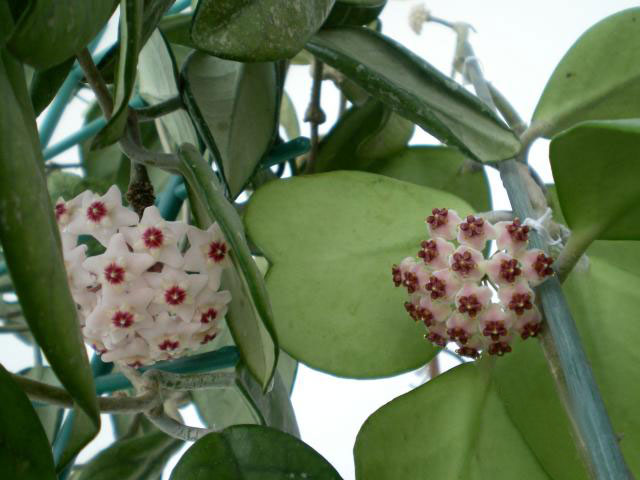
The sweetheart plant. Heart-shaped fleshy leaves, succulent from Asia, very slow grower. NON toxic. The famous 'single leaf' never grows without a node.
- Difficulty Easy
- Light Bright indirect
- Watering Sparse
- Toxicity No known hazard
© Wikimedia Commons, free license (Hobbykafe, CC BY-SA 3.0)
Family
Apocynaceae
Origin
Southeast Asia (Thailand, Cambodia, Laos, Vietnam, southern China, Java)
- non toxic
- easy
- succulent
- gift plant
- valentines day
- slow grower
The sweetheart plant
The Hoya kerrii, famously known as the sweetheart plant, Valentine Hoya or lucky heart, has become in a few years one of the most gifted botanical presents on Valentine’s Day. Its single perfectly heart-shaped leaf, sold in a small clay pot, condenses the symbolic language of affection into a living object. But behind this flawless marketing image hides a surprising plant, demanding patience and carrying a very real trap that most buyers ignore.
Native to the seasonally dry tropical forests of Southeast Asia (Thailand, Cambodia, Laos, Vietnam, southern China, some Indonesian islands including Java), Hoya kerrii grows naturally as an epiphytic vine clinging to tree trunks. Its stems can reach 3 to 4 meters in their habitat and bear dozens of medium to dark green, particularly fleshy heart-shaped leaves. This leaf thickness (3 to 5 mm) makes it a true succulent, capable of storing water for weeks.
The species belongs to the Hoya genus, like the famous Hoya carnosa or porcelain flower. The genus includes over 300 species, all in the Apocynaceae family. Swedish botanist Karl Bock discovered the species in 1911 and named it after plant collector Arthur Francis George Kerr, physician and botanist active in Thailand in the early 20th century.
The single leaf myth
This is the major commercial trap of Hoya kerrii. Each year, millions of “sweetheart plants” are sold on Valentine’s Day in the form of a single leaf planted in a small pot, sometimes adorned with a bow. These leaves are beautiful, can live for several years unchanged, but have a fundamental flaw: they never grow.
The reason is botanical. For a Hoya cutting to produce new stems and new leaves, it must include at least one node, meaning the insertion point of a leaf on the stem where an axillary bud is located. This bud contains meristematic tissue, the only one capable of producing new cells organized into stem and leaves.
A leaf alone, cut without a stem segment, contains no bud. It can form roots (step 1 of classical cutting), survive several years feeding itself, but will never produce a new shoot. It will remain frozen as a single leaf.
See the full guide Hoya kerrii single leaf not growing to understand, verify, and possibly transform a single leaf into a complete plant.
Growth: exceptionally slow
Even with a cutting that includes a node, Hoya kerrii is known for its extremely slow growth. Count 5 to 15 cm of new stem per year under optimal conditions. A potted plant may take 5 to 10 years to reach 1 meter in length.
This slowness is explained by the plant’s strategy: it favors water storage and robustness over speed. Each new fleshy leaf represents a considerable investment in biomass. The plant therefore produces only a few per year, but they last for decades.
Practical consequence: a well-cared-for Hoya kerrii can live over 25 years and often several decades. This is not a plant for those who want to see a jungle grow before their eyes, it is a heritage plant that accompanies a lifetime.
Varieties to know
Hoya kerrii standard (solid green): the wild form with medium to dark green leaves.
Hoya kerrii variegata: cream/yellow center with green border. Even slower growth than the standard and more demanding in light.
Hoya kerrii albomarginata: cream/white border with green center. Reverse effect of variegata.
Hoya kerrii splash: dark green leaves splashed with small silver dots. Very decorative.
Hoya kerrii reverse variegated: green center with yellow-cream edge, particular behavior.
All these varieties follow the same care. The variegated forms demand more light to maintain their coloration and grow even more slowly than the standard.
Light, watering, substrate
Light. Bright indirect to gentle direct sun essential. Ideal position: in front of an east or west window, or south with sheer curtain in summer. In too low light (more than 1.5 m from a window, pure north exposure), the plant survives indefinitely but does not grow at all and will never flower. Variegated varieties demand even more light to maintain their markings.
Watering. Every 15 to 21 days in summer, every 4 to 6 weeks in winter. Hoya kerrii is one of the most drought-tolerant Hoyas thanks to its very fleshy leaves. The substrate must dry completely between waterings, almost until leaves begin to soften slightly. Mistake number one is overwatering which causes root rot and loss of the plant within weeks.
Humidity. 40 to 60 percent is amply sufficient. Like Hoya carnosa, Hoya kerrii perfectly tolerates the dry air of heated apartments. No humidifier needed generally.
Substrate. Maximum drainage mandatory. Recommended mix: 40% green plant potting soil + 30% perlite + 20% fine orchid bark + 10% pumice or coarse sand. Pot with drainage imperative. The plant prefers a slightly small pot that dries quickly.
Temperature. 18 to 28 degrees Celsius ideal. Tolerates 12 to 32 degrees. Sensitive to cold drafts and abrupt temperature changes.
Fertilizer. Every 4-6 weeks from April to September, cactus and succulent fertilizer or flowering fertilizer at half dose. No fertilizer in winter.
Flowering: a rare and precious event
Hoya kerrii flowers, but rarely and late. Conditions are strict:
- Plant aged 5 to 8 years minimum
- Abundant light with gentle direct sun
- Marked winter water stress
- Peduncles never cut (absolute rule valid for all Hoyas)
Flowering produces compact umbels of 15 to 25 waxy flowers, white to cream with red or purple heart, lightly fragrant in the evening. More discreet than those of Hoya carnosa but just as precious. A single umbel can last several weeks.
Absolute rule: NEVER cut peduncles, even dry ones. They re-bloom at the same spot every year for decades.
Propagation: node mandatory
Propagation is easy provided you respect the node rule.
Stem with node method (which works):
- Cut a stem section with at least 1-2 visible nodes
- Remove the leaf at the lowest node to expose the bud
- Soak in water or plant directly in moist draining substrate
- Visible roots in 3-6 weeks
- New growth visible in 2-6 months
Single leaf method (which does NOT work): leaf cut without a stem segment. Forms roots, survives indefinitely, but never produces a new shoot. This is the commercial Valentine’s gift method.
A 100 percent safe plant for the home
Like all Hoyas, Hoya kerrii is non-toxic to cats, dogs, and humans.
For cats: NON toxic according to the ASPCA. See Hoya kerrii non-toxic to cats.
For dogs: NON toxic according to the ASPCA. See Hoya kerrii non-toxic to dogs.
For humans: no recognized toxic compound. The white milky sap contains natural latex without toxicity. Minor precautions for very sensitive skin: gloves when propagating.
Precautions: none particular as a rule. Plant suitable for households with pets or young children.
Common symptoms to watch
| Symptom | Probable cause | Solution |
|---|---|---|
| Single leaf not growing | Absence of node | Check for node, otherwise non-recoverable |
| Yellow leaves | Excess water most often | Space out watering |
| Wrinkled and soft leaves | Prolonged under-watering | Rehydrate gradually |
| Growth blocked for years | Insufficient light or normal state | Reposition in bright light |
| Leaves drop suddenly | Thermal shock or rot | Check roots, stabilize |
| Mealybugs | Dry air, isolation | Black soap + 70 degree alcohol |
| Never flowers | Plant too young or lack of winter stress | Be patient, trigger protocol |
Common problems and how Spriggo helps
Visual diagnosis remains the fastest method to identify a problem on Hoya kerrii. The Spriggo app lets you photograph the affected area and get a diagnosis in seconds, with the corrective actions to take. Discover single leaf not growing, yellow leaves, wrinkled leaves, watering protocol and mealybug treatment.
Diagnose this plant
-
Disease
Mealybugs on Hoya kerrii: identification and treatment
Mealybugs on Hoya kerrii: why this sweetheart plant is so vulnerable, how to identify in 2 minutes, complete treatment and prevention.
-
Toxicity
Hoya kerrii and cats: NON toxic, 100% safe plant
Hoya kerrii listed as NON toxic for cats by the ASPCA. No dangerous compound. Minor precautions and tips if very playful cat.
-
Toxicity
Hoya kerrii and dogs: NON toxic, 100% safe plant
Hoya kerrii listed as NON toxic for dogs by the ASPCA. No dangerous compound. Minor precautions and tips if puppy or food-driven dog.
-
Care
Watering a Hoya kerrii: exact protocol by season
Hoya kerrii: every 15-21 days in summer, 4-6 weeks in winter. Succulent very tolerant of drought. Method, water, frequency and mistakes to avoid.
-
Diagnosis
Hoya kerrii yellow leaves: 5 causes and solutions
Yellow leaves on Hoya kerrii: overwatering most often, insufficient light, thermal shock, normal aging. Exact diagnostic and recovery protocol.
-
Diagnosis
Hoya kerrii: why the single leaf never grows
The single Hoya kerrii leaf bought on Valentine's Day will never grow without a node. Botanical explanation, how to verify, and how to save the gift.
-
Diagnosis
Hoya kerrii wrinkled leaves: 4 causes and solutions
Wrinkled leaves on Hoya kerrii: prolonged underwatering, paradoxical root rot, damaged roots, transfer shock. Exact diagnostic and rehydration protocol.