
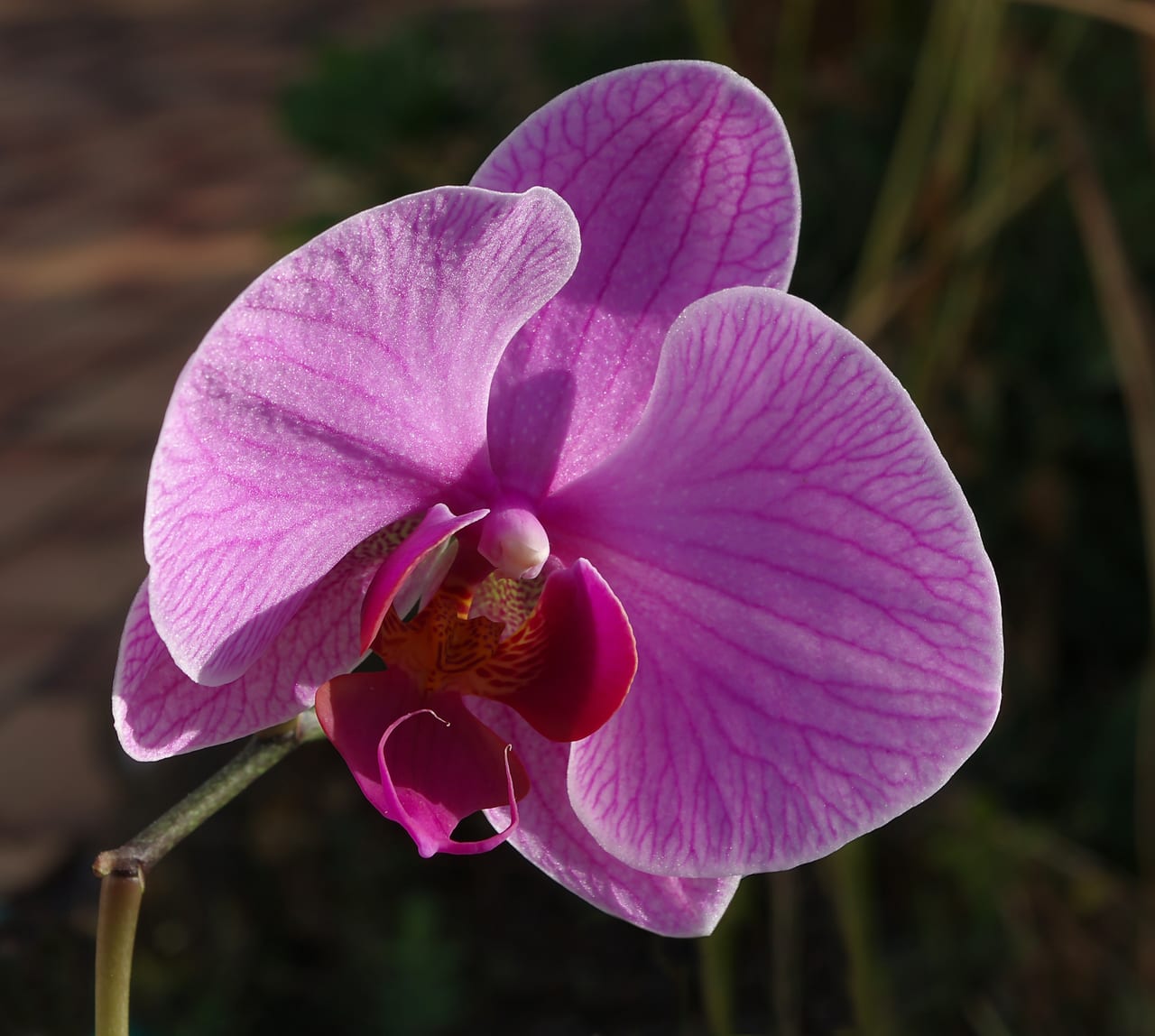
Orchidaceae
Phalaenopsis orchid
Phalaenopsis sp.
The world's best-selling orchid. Spectacular bloom lasting months, manageable rebloom. Non-toxic to pets.
- Difficulty Moderate
- Light Bright indirect
- Watering Once a week
- Toxicity No known hazard
© Orchi, CC BY-SA 3.0
Family
Orchidaceae
Origin
Tropical forests of Southeast Asia, Philippines, Indonesia
- orchid
- flowering plant
- epiphyte
- non toxic
- long bloom
- tropical
The orchid that changed everything
The Phalaenopsis, nicknamed moth orchid, has become in forty years the world’s best-selling flowering houseplant. In France, more than 30 million pots are sold each year, more than all other orchids combined. The reason for this dominance: it blooms for a long time (2 to 6 months without interruption), it forgives mistakes, it is happy with a window corner, and each spike can produce flowers again a year later.
Native to the tropical forests of Southeast Asia (Philippines, Indonesia, Borneo, Taiwan), Phalaenopsis grows in the wild glued to tree trunks, under the canopy. It does not grow in soil. Its roots, exposed to air, capture atmospheric moisture and grip bark. Botanists call it an epiphyte, and that is the key to understanding all its care.
Phalaenopsis sold in garden centers are almost all hybrids from crosses between about twenty wild species. Colors: pure white, soft pink, fuchsia, yellow, burgundy, sometimes spotted or striped. Sizes: from nano (15 cm) to standard (60 cm) to large cultivars (1 meter).
Why Phalaenopsis is different
Three characteristics make this orchid unique among flowering houseplants.
It is epiphytic. The roots need air, not soil. The substrate must be almost only pine bark, with some coconut fiber fragments and moss. If put in classic potting mix, the roots rot within weeks.
It has a very slow growth cycle. A new leaf takes 4 to 6 months to form. A new flower spike appears once or twice a year. Patience required. Instant gratification is not its strength.
It lives long if its rules are respected. A well-maintained Phalaenopsis lives 10 to 20 years, reblooms every year, and gradually grows. A long-term investment, not a seasonal plant.
Light, watering, substrate
Light. Bright but indirect. Best exposure: 1 or 2 meters from an east or southeast window. Direct south sun in summer burns leaves within hours. Conversely, in a corner too dark, the plant survives but never blooms. Visual indicator: leaves of a well-lit Phalaenopsis are medium green leaning slightly toward red at the edges. Uniform dark green = lack of light.
Watering. Every 7 to 10 days in summer, every 14 to 21 days in winter. The universal method: dip the pot 10 to 15 minutes in a basin of room-temperature water, then drain well. Rainwater or filtered water is preferable. Never let water sit in the cachepot, the leading cause of root rot. The pot should be transparent to see the roots (color indicates hydration: green well-hydrated, silver-gray needs water).
Substrate. Coarse pine bark 70 percent, coconut fiber 20 percent, sphagnum moss 10 percent. Never classic potting mix. The substrate is renewed every 2 to 3 years as bark decomposes and loses its aeration.
Humidity. Moderate to high, ideally 50 to 70 percent. Bathroom is a good location if it has a window. Otherwise, group several orchids on a tray with pebbles and water to increase local humidity.
Temperature. 18 to 27 degrees during the day, never below 15 degrees. To trigger rebloom, expose to a nighttime temperature drop (5 to 8 degrees less than day) for 3 to 4 weeks in autumn.
The flowering cycle
What passionate amateurs and frustrates beginners.
Phase 1, blooming: 2 to 6 months depending on hybrid. During this period, water normally, do not move the plant, do not change orientation. Flowers fall one by one at cycle end.
Phase 2, rest: 2 to 4 months. Flower spike yellows and dries. Water more spaced out. No fertilizer. The plant rebuilds energy reserves.
Phase 3, rebloom triggering: autumn (October-November). Expose to a nighttime temperature drop of 5 to 8 degrees. A new spike emerges at the base of a leaf in 4 to 8 weeks.
Phase 4, spike growth: 6 to 12 weeks. Buds appear then grow. Never move the plant at this stage, buds would fall.
Phase 5, flower opening: back to phase 1. Bloom again for 2 to 6 months.
A well-maintained Phalaenopsis reblooms 1 to 2 times a year for 10 to 20 years.
Common symptoms to watch
| Symptom | Likely cause | Solution |
|---|---|---|
| Yellow leaves | Excess water or aging | Space waterings, check roots |
| Soft leaves | Rotted roots or dehydration | Check roots, adjust watering |
| Brown soft roots | Root rot | Cut, repot in dry substrate |
| Bud drop | Thermal shock, moving | Stabilize environment |
| No rebloom | Lack of light or temperature drop | Reposition and stratify nights |
| Wrinkled leaves | Chronic dehydration | Water more often, check roots |
For each problem, see detailed guides in the Diagnose this plant section.
A non-toxic plant for pets
The entire Orchidaceae family (Phalaenopsis, Cattleya, Cymbidium, Dendrobium, Vanda, Oncidium) is classified non-toxic by the ASPCA for cats, dogs, and humans. One of the few spectacular flowering plants that can safely cohabit with pets. Flowers, leaves, roots, and spikes are chemically inert. Massive ingestion might at worst cause mild digestive upset, like any plant matter.
A differentiating argument against other indoor flowering plants: Anthurium, Spathiphyllum, Hippeastrum, Cyclamen, Poinsettia are all toxic to cats. Phalaenopsis is not.
Diagnose this plant
-
Disease
Phalaenopsis orchid root rot: save the plant
Phalaenopsis root rot: disease #1 of the species, caused by overwatering and used substrate. Identify rotted roots, 4-step rescue, prevention.
-
Diagnosis
Phalaenopsis dropping flowers: 5 causes and solution
Phalaenopsis dropping flowers: natural end of cycle in 50 percent of cases, thermal shock, draft, moving, or pollination. Exact diagnosis.
-
Diagnosis
Phalaenopsis with soft leaves: 3 causes and solution
Soft leaves on Phalaenopsis: rotted roots in 70 percent of cases, dehydration, or thermal shock. Diagnosis and 7-day action plan.
-
Toxicity
Is Phalaenopsis orchid toxic to cats? Veterinary answer
Phalaenopsis is not toxic to cats. Classified non-toxic by ASPCA, no oxalates, no saponins. Safety details, behaviors, prevention.
-
Toxicity
Is Phalaenopsis orchid toxic to dogs? Veterinary answer
Phalaenopsis is not toxic to dogs. Classified non-toxic by ASPCA, no oxalates, no saponins. Safety details, behaviors, prevention.
-
Care
Watering a Phalaenopsis: method, frequency, water, mistakes
Complete Phalaenopsis watering guide. 10-min soak every 10 to 14 days, lukewarm filtered water, transparent pot mandatory. Mistakes to avoid.
-
Diagnosis
Phalaenopsis orchid with yellow leaves: 4 causes diagnosed
Yellow leaves on Phalaenopsis: excess water in 60 percent of cases, natural aging, direct sun, or deficiency. Identify the cause and stop the yellowing.