
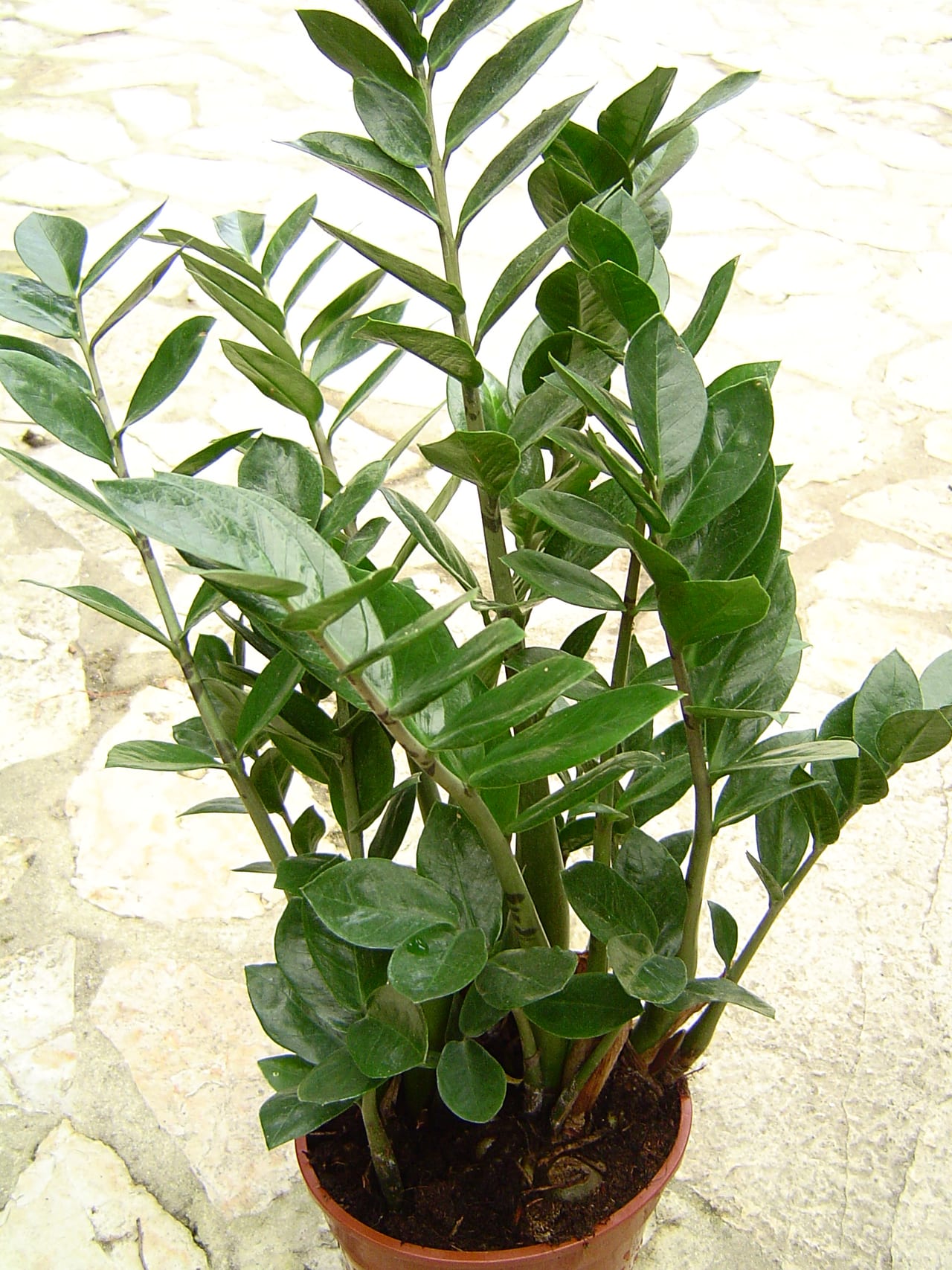
Araceae
ZZ plant
Zamioculcas zamiifolia
The indestructible bureaucrat of houseplants. Survives shade, neglect, dry air. Toxic to pets.
- Difficulty Easy
- Light Low
- Watering Sparse
- Toxicity Toxic to cats
© Photo by David J. Stang, CC BY-SA 4.0
Family
Araceae
Origin
East Africa, Tanzania, Zanzibar
- houseplant
- easy
- tolerant
- air purifier
- graphic foliage
- low light
The plant for the distracted
Zamioculcas zamiifolia, better known as ZZ plant, has become in twenty years the favorite houseplant of offices, hotels, and urban apartments with low light needs. The reason: it is almost indestructible. Survives 3 weeks without watering, tolerates hallway shade, withstands dry heated air, and resists prolonged neglect. A plant tailored for distracted modern life.
Native to East Africa (Tanzania, Zanzibar, eastern Kenya), it grows in rocky understory where water is scarce and light filtered. Its survival rests on a fleshy bulbous rhizome below the substrate, which stores water like a cactus. The shiny dark green leaves grow on rigid arching stems reaching 60 to 90 centimeters indoors.
The “ZZ plant” nickname comes simply from the two Z’s of its Latin name. No mysticism, just practical.
Why so many people choose it
Three characteristics explain its commercial success.
Tolerates low light like no other. Survives in a room with only 1 to 2 hours of indirect light per day. Most houseplants demand much more.
Forgives missed watering. The rhizome stores water for weeks. A ZZ can go 3 to 4 weeks without water in winter without visible damage.
Slow but regular growth. No spectacular blooming, no seasonal stress, just new stems appearing 1 to 3 times a year. Stable, predictable.
The flip side: toxicity
The only real flaw. ZZ plant contains calcium oxalate crystals in microscopic needles in all parts (leaves, stems, rhizome). When a cat or dog chews a leaf, these crystals penetrate the buccal mucosa and cause immediate very painful irritation, followed by salivation, vomiting, sometimes edema.
For a household with pets: ZZ to avoid or place absolutely out of reach. For an apartment without pets: no problem, risk to an adult human is nil (except long handling without gloves for sensitive people).
Light, watering, substrate
Light. Tolerates low to bright indirect. Ideal: 2 to 4 meters from an east or north window. Direct south sun to avoid (leaves shine less, edges brown). Survives even in a hallway without nearby window, but slower growth. Prefers natural light even just a few hours per day.
Watering. Every 14 to 21 days in summer, every 21 to 30 days in winter. Critical step: let substrate dry completely between waterings. Test with finger 5 cm deep: if moist, wait. The rhizome stores water, so better underwater than overwater. Excess water = rhizome rot = death within weeks.
Substrate. Draining. Mix: 50% classic potting soil, 30% perlite, 20% horticultural sand. Pot with drainage holes mandatory. No heavy substrate retaining water.
Humidity. Tolerates dry heated apartment air without complaint. 30 to 50 percent is plenty.
Temperature. 18 to 26 degrees ideal. Never below 10 degrees in winter. Sensitive to prolonged cold.
Fertilizer. Very little. Once every 2 to 3 months in growing season (April to September), houseplant fertilizer diluted to half the recommended dose. Not in winter.
Growth and repotting
Slow growth: 1 to 3 new stems per year, each taking 2 to 4 months to fully deploy. An adult ZZ reaches 60 to 90 centimeters tall.
Repotting every 3 to 4 years, in spring. The rhizome tends to crack the pot when it grows too large: repotting signal. Choose a pot 3 to 5 cm larger in diameter only.
Propagation
Three possible methods:
Rhizome division at repotting time. Gently separate rhizome sections with their roots and stems, replant in individual pots. Recovery in 1 to 2 months.
Stem cutting. Cut a healthy stem, plant directly in moist substrate. Very slow recovery (4 to 8 months for roots).
Leaf cutting. Detach a leaflet cleanly at the base, lay it flat on moist sphagnum moss. A miniature new rhizome forms at the base in 6 to 12 months. Long but fascinating.
Common symptoms to watch
| Symptom | Likely cause | Solution |
|---|---|---|
| Yellow leaves | Overwatering | Space out, check rhizome |
| Soft stems | Rhizome rot | Remove, cut, repot dry |
| Brown tips | Tap water too hard | Filtered water |
| Halted growth | Light deficiency | Reposition |
| Falling leaves | Thermal shock or stress | Stabilize environment |
| Mealybugs | Air too dry, isolation | Insecticidal soap treatment |
For each problem, see detailed guides at the bottom of the page.
A toxic plant: precautions
For a household with cats, dogs, or young children, ZZ should be placed:
Up high on furniture inaccessible to animals and out of children’s reach.
In a dedicated room where animals do not enter (closed office for example).
With a heavy cachepot that prevents tipping.
If an animal has bitten a leaf, immediately rinse the mouth with clear water, provide fresh water access. Symptoms (salivation, oral pain, vomiting) appear within minutes and generally last 24 hours. Consult a vet if the cat or dog refuses to drink or eat for more than 12 hours, or if salivation is significant.
See detailed articles ZZ plant toxic to cats and ZZ plant toxic to dogs for complete protocols.
Diagnose this plant
-
Living conditions
ZZ plant in low light: what it really tolerates
ZZ plant in low light: tolerates 1 to 2 hours of indirect light per day. Queen of dim corners. Limits and warning signals.
-
Disease
Mealybugs on ZZ plant: identify, treat, prevent
Mealybugs on ZZ plant: pest #1 favored by dry air. Identify white cottony clumps, treat with insecticidal soap, prevent. Complete method.
-
Diagnosis
ZZ plant with soft stems: rhizome rot, save the plant
Soft stems on ZZ plant: rhizome rot in 95 percent of cases. 4-step rescue, prevention. The only real warning signal of this species.
-
Toxicity
ZZ plant toxic to dogs: protocol and precautions
ZZ plant TOXIC to dogs. Calcium oxalate crystals cause oral irritation, salivation, vomiting. Emergency protocol and prevention.
-
Care
Watering a ZZ plant: frequency, method, mistakes
Complete ZZ plant watering guide. Every 14 to 21 days in summer, 21 to 30 in winter. Mandatory finger test. The killer mistake: overwatering.
-
Toxicity
ZZ plant toxic to cats: protocol and precautions
ZZ plant TOXIC to cats. Calcium oxalate crystals cause oral irritation, salivation, vomiting. Emergency protocol and prevention.
-
Diagnosis
ZZ plant with yellow leaves: 4 causes and the real one
Yellow leaves on ZZ plant: overwatering in 80 percent of cases, aging, direct sun, or thermal shock. Exact diagnosis and solution.