
Asparagaceae
Corn plant
Dracaena fragrans
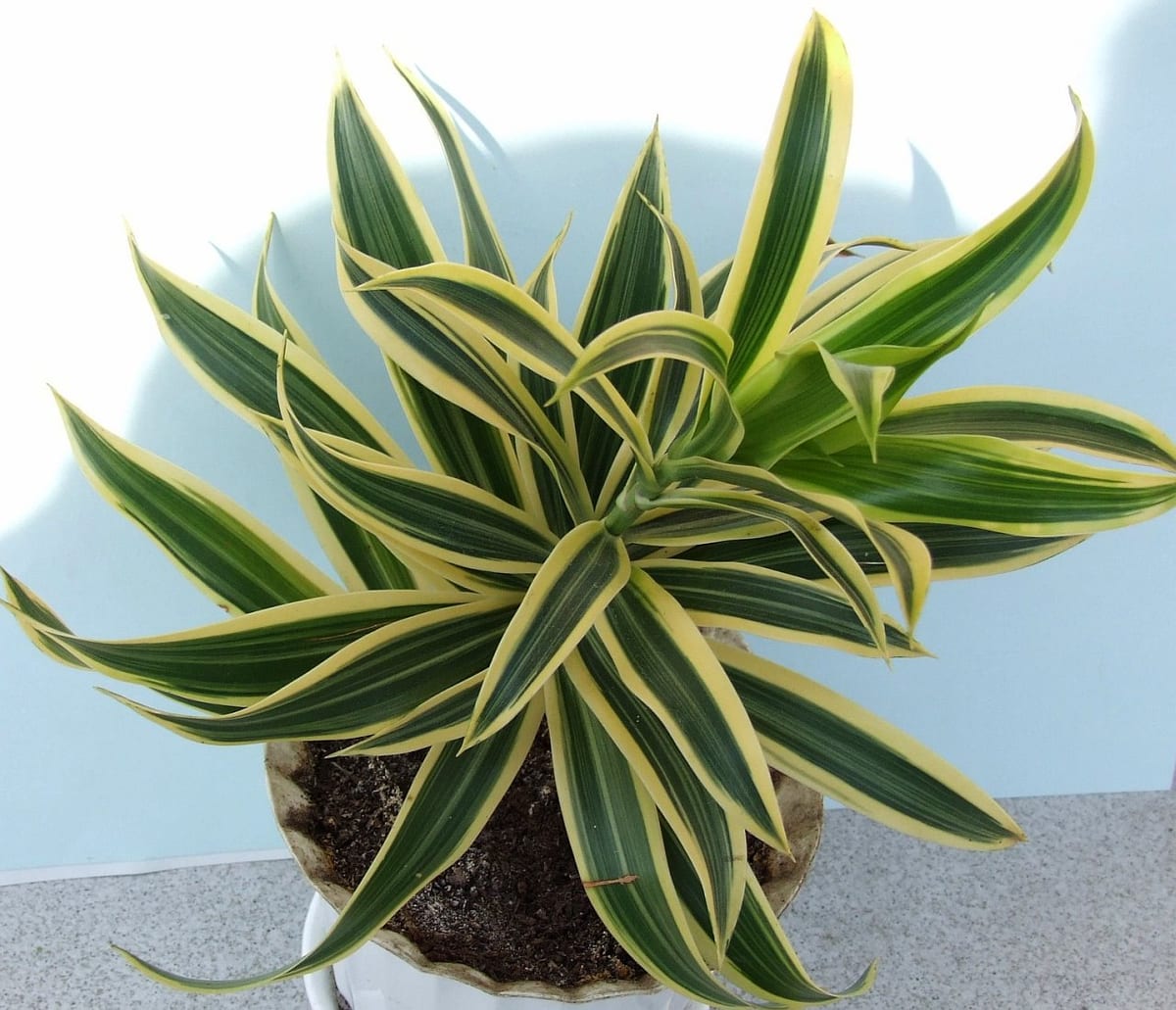
The corn plant with broad yellow-striped leaves. Tolerates neglect, NASA air-purifier. Toxic to pets.
- Difficulty Easy
- Light Indirect
- Watering Sparse
- Toxicity Toxic to cats
© Forest & Kim Starr, CC BY 3.0
Family
Asparagaceae
Origin
Tropical Africa (Sudan, Tanzania, Mozambique)
- tropical
- houseplant
- easy
- low light
- air purifier
- variegated
The classic indoor corn plant
Dracaena fragrans, commonly called the corn plant, fragrant dracaena, or mass cane, is one of the great indoor classics since the 1960s. Its most widespread cultivar, ‘Massangeana’, is immediately recognizable by its central yellow-gold band on each leaf, a distinctive visual signature.
Native to tropical Africa (Sudan, Tanzania, Mozambique, Ivory Coast), Dracaena fragrans grows wild in clear understory up to 15 meters. Indoors, it appears as a miniature tree: thick ramified trunk topped with bouquets of long broad leaves (40-90 cm) glossy dark green striped with yellow.
Don’t confuse with:
- Dracaena marginata (Madagascar dragon tree): narrow leaves edged red
- Dracaena sanderiana (lucky bamboo): thin stalks sold in arrangements
- Cordyline: narrower leaves often red/purple
Why so many choose it
Three durable success characteristics.
Tolerates forgotten waterings. Easily survives 3-4 weeks without water. Fleshy trunk stores water. Ideal for offices and beginners.
Tolerates moderate light. No need for south window. A room with indirect natural light suffices. Survives in neon-lit offices.
NASA-recognized air-purifier. Clean Air studies (1989) confirm Dracaena fragrans’s effectiveness at filtering formaldehyde, benzene, trichloroethylene. One of the best air-purifiers in the NASA panel.
The yellow variegation: signature to protect
The ‘Massangeana’ cultivar (best-selling) owes its central yellow band to a genetic variegation mechanism. This band needs sufficient light to form: in too-low light, new leaves become uniformly green (the plant “gives up” variegation as it slows photosynthesis).
It’s an early warning signal of light deficiency. See Corn plant fading variegation for full diagnosis.
Light, watering, substrate
Light. Moderate to bright indirect. Ideal: 1-2 m from east, west or north window. Tolerates darker (3-4 m) but yellow variegation disappears. Direct south sun to avoid (burns leaves).
Watering. Every 10-14 days in summer, every 18-21 days in winter. Substrate should dry on surface between waterings. Rainwater or filtered water preferable, fluoride-sensitive like all Dracaenas (guaranteed brown tips with tap water in fluoridated regions).
Substrate. Draining. Mix: 50% green plant potting mix, 30% perlite, 20% coarse sand. Pot with drainage mandatory.
Humidity. Tolerates dry air (30-40%). Ideal 40-60%.
Temperature. 18 to 26 degrees. Not below 13 degrees.
Fertilizer. Every 2 months in growing season (April-September), green-plant fertilizer at half-dose. Not in winter.
Growth and care
Growth: 10-20 cm per year. Adult height 1.50 to 3 meters indoors after 10-15 years. In the wild: up to 15 meters.
Repotting every 3-4 years, in spring. Pot 2-3 cm wider.
Pruning: to limit height, cut the trunk at desired height with disinfected pruners. Plant regrows forming 2-4 new heads at the cut point. Cut stem can be propagated.
Propagation: cut 15-30 cm trunk portion, let dry 2-3 days, plant in moist draining substrate. Roots in 4-8 weeks. Mark direction (top/bottom) on cutting.
Rare indoor flowering: very fragrant white flower clusters (hence “fragrans” name). Requires mature plant over 10 years, full bright indirect light. Typically once a decade.
Common symptoms to watch
| Symptom | Likely cause | Solution |
|---|---|---|
| Brown tips | Hard water/fluoride | Filtered water |
| Yellow stripe disappeared | Lack of light | Reposition |
| Yellow lower leaves | Aging | Cut |
| All leaves yellow | Overwatering | Inspect roots |
| Brown soft leaves | Root rot | Emergency repot |
| Halted growth | Lack of light | Reposition |
| Mealybugs | Dry air, isolation | Insecticidal soap |
A toxic plant for pets
Dracaena fragrans contains steroidal saponins (like Dracaena marginata), more serious toxins than Araceae oxalates. Symptoms in cats and dogs:
- Vomiting (sometimes bloody in cats)
- Excessive salivation, depression
- Characteristic dilated pupils in cats
Keep out of reach of pets. See Corn plant toxic to cats and to dogs.
Diagnose this plant
-
Diagnosis
Corn plant brown leaves: 4 causes (water and sun)
Brown leaves on Dracaena fragrans: tap water first, overwatering, direct sun, or aging. Exact diagnosis and solution.
-
Diagnosis
Corn plant brown tips: tap water fluoride (70%)
Brown tips on Dracaena fragrans 'Massangeana': tap water fluoride first, dry air, over-fertilization, or stress. Solutions.
-
Toxicity
Is Corn plant toxic to cats? (yes, saponins)
Corn plant toxic to cats. Steroidal saponins: vomiting, dilated pupils, depression. More serious than Araceae. Emergency steps.
-
Disease
Mealybugs on Corn plant: eliminate in 4 weeks
Mealy and scale insects on Dracaena fragrans: recognize, treat with insecticidal soap + alcohol, prevent. Complete plan.
-
Toxicity
Is Corn plant toxic to dogs? (yes, saponins)
Corn plant toxic to dogs. Steroidal saponins: vomiting, depression, weakness. Supervision and safe alternatives.
-
Care
Watering a Corn plant: frequency, water, complete method
Every 10-14 days in summer, 18-21 in winter. Fluoride-free water mandatory. Method and trunk propagation included.
-
Diagnosis
Corn plant yellow leaves: overwatering in 70% of cases
Yellow leaves on Dracaena fragrans: overwatering first, basal aging, lack of light, or deficiency. Diagnosis and solution.
-
Diagnosis
Corn plant fading variegation: light, almost always
Yellow stripe disappearing on Dracaena 'Massangeana': insufficient light in 90 percent of cases. Diagnosis and corrective plan.