
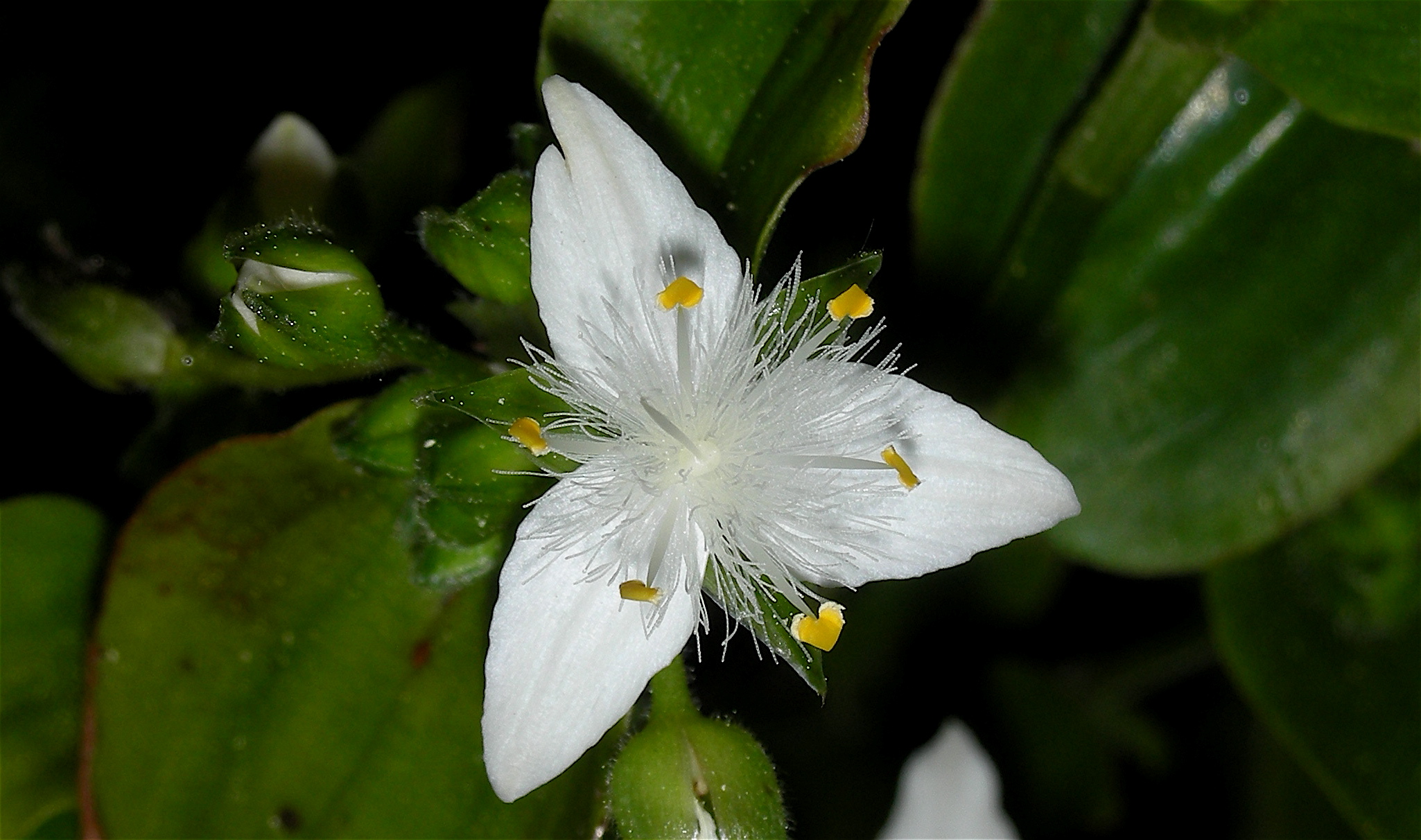
Commelinaceae
Tradescantia fluminensis
Tradescantia fluminensis
Small-leaf spiderwort. Ultra-easy trailing houseplant with small green or variegated leaves in cream and pink. Mildly toxic to cats and dogs, lightning growth.
- Difficulty Easy
- Light Bright indirect
- Watering Once a week
- Toxicity Toxic to cats
© Wikimedia Commons, free license (Enrique Dans, CC BY 2.0)
Family
Commelinaceae
Origin
Brazil and Argentina (Atlantic forests of eastern South America)
- easy care
- fast growing
- trailing
- hanging plant
- decorative foliage
- variegated
Small-leaf spiderwort: less flashy but more invasive than zebrina
Tradescantia fluminensis, commonly called small-leaf spiderwort, inch plant, or simply wandering tradescantia in modern guides, is one of the most widely grown houseplants in the world. Less colorful than its cousin the Tradescantia zebrina, it makes up for it with absolute simplicity of care and phenomenal growth speed. A single cutting produces a full plant in weeks, and the species tolerates almost anything: forgotten watering, mediocre light, poor soil, aggressive pruning.
Native to the Atlantic forests of southeastern Brazil and northeastern Argentina, Tradescantia fluminensis grows naturally as a ground-covering plant on humid forest floors, forming dense mats that sometimes blanket several hectares. This adaptation explains its dual personality: docile houseplant for you, fearsome invasive species in mild climates. It is classified as a major invasive species in New Zealand, Australia, the southern United States, Portugal, and several Mediterranean regions.
The genus name Tradescantia honors John Tradescant the Elder, head gardener to King Charles I of England in the 17th century. The species name fluminensis is Latin for “of the river” or “of riverbanks,” referring to its natural habitat near humid stream banks in Brazil. The historical English name “Wandering Jew” is now avoided for ethical reasons, replaced by small-leaf spiderwort or inch plant in contemporary sources.
How it differs from Tradescantia zebrina: do not confuse them
Many nurseries sell both species interchangeably under the generic name “wandering plant,” but they are very different visually and biologically.
Tradescantia zebrina has fleshier, larger leaves (5 to 10 cm), striped silver on dark green with intense purple undersides. Tradescantia fluminensis has smaller leaves (2 to 6 cm), bright pale green in the wild form, thin and translucent. The undersides are pale green, only slightly tinged with purple on certain cultivars.
Fluminensis grows even faster than zebrina, and tolerates low light far better. On the other hand, its variegation (on Tricolor or Quicksilver varieties) is much more fragile and disappears rapidly in dim interiors. See the guide Tradescantia fluminensis losing variegation for diagnosis.
Varieties to know
Tradescantia fluminensis wild form: fully green, smooth, glossy leaves. The most vigorous and invasive version. Often used as ground cover in mild climates.
Tradescantia fluminensis Tricolor (sometimes called Quicksilver): variegated cream, green and pale pink. The most popular indoors. Slightly slower growth, demanding for light.
Tradescantia fluminensis Albovittata: broad white stripes on green, without pink. Very luminous effect, popular in hanging baskets.
Tradescantia fluminensis Variegata: irregular cream and green variegation, intermediate between Tricolor and Albovittata.
Tradescantia fluminensis Aurea: fully golden yellow leaves in full light, pale green in moderate light. Decorative cultivar.
Tradescantia fluminensis Maiden’s Blush: vivid pink variegation on young leaves, fading later. Highly sought after by collectors.
All variegated varieties share the same critical requirement: constant bright light to keep their colors. Otherwise they regress rapidly toward the green form through selection of non-variegated shoots.
Light, watering, substrate
Light. Bright indirect is ideal. The green form tolerates partial shade without issue. Variegated varieties require at least 4 to 6 hours of bright indirect light per day, otherwise they produce fully green shoots that eventually dominate the plant. Position in front of east, west, or south windows with sheer curtains. No harsh direct summer sun (thin leaves quickly mark with dry patches).
Watering. Every 5 to 7 days in summer, every 10 to 14 days in winter. Tradescantia fluminensis prefers a consistently slightly moist substrate without excess. Its drought tolerance is better than zebrina but its thin stems wilt within 2 to 3 days of fully dry substrate. Good news: recovery is almost immediate after watering. See the detailed protocol: watering Tradescantia fluminensis.
Humidity. 40 to 60 percent works perfectly. No need for a humidifier or misting. The plant tolerates dry heated apartment air.
Substrate. Light free-draining all-purpose mix. Recommended blend: 70 percent houseplant potting soil, 20 percent perlite, 10 percent vermiculite. Drainage hole required. The plant is not picky about substrate quality and grows even in coarse compost or garden soil.
Temperature. 15 to 26 degrees Celsius ideal. Tolerates 10 to 30 degrees. Below 8 degrees, leaves soften and fall. Avoid cold drafts in winter.
Fertilizer. Every 2 to 3 weeks from April to September, all-purpose fertilizer at half strength. The plant’s natural vigor consumes plenty of nitrogen. Suspend feeding in winter. Excess fertilizer on variegated varieties causes loss of variegation (nitrogen favors chlorophyll).
Propagation: the easiest plant in the world to propagate
Tradescantia fluminensis is arguably the easiest houseplant to propagate in the entire plant kingdom. Success rate close to 100 percent, by any method.
Water method. Cut a 5 to 12 cm stem just below a node. Remove leaves from the bottom third. Place in a glass of water with the bare part submerged. Roots visible in 2 to 5 days. Pot up when roots reach 2 to 4 cm.
Direct soil method. Push the cutting straight into moist substrate without preparation. Roots in 7 to 12 days. As effective as the water method, faster to settle the plant.
Fragment method. A simple piece of stem with a node, laid on moist substrate, eventually roots. This property is exactly what makes the plant so invasive outdoors: an escaped fragment can colonize several square meters in one season.
Tip: plant 8 to 12 cuttings simultaneously in the same pot for a dense jungle effect in 2 to 3 months. Every cutting roots, without exception.
Toxicity: precautions for cats, dogs and humans
Unlike popular non-toxic plants such as Pilea peperomioides or Hoya carnosa, Tradescantia fluminensis is mildly toxic to cats and dogs according to ASPCA and several veterinary poison centers.
For cats: can cause contact dermatitis (skin irritation, itching, redness) and mild digestive disturbances if chewed (excessive drooling, transient vomiting). See Tradescantia fluminensis toxic to cats for symptoms and what to do.
For dogs: very similar symptoms, generally mild. Dogs with light coats and thin skin are more prone to contact irritation. See Tradescantia fluminensis toxic to dogs.
For humans: sap may cause skin irritation in sensitive individuals, especially during repeated propagation. A few cases of occupational dermatitis have been reported among horticultural workers. Wear gloves if your skin is sensitive.
General precautions: place the plant up high (hanging basket, shelf) out of reach of curious pets. The toxicity is not severe but is easily avoided.
The invasive species status: must-know context
Tradescantia fluminensis is classified as a major invasive species in around fifteen countries. Its ability to form dense mats that smother native vegetation, its propagation by simple fragment, and its tolerance of varied conditions make it a serious ecological threat in mild climates.
Countries where the species is banned or strictly regulated: New Zealand (ban on sale, transport and propagation since 2008), Australia (Weed of National Significance), Portugal (listed invasive), United States in Florida, Hawaii and coastal California (documented by USDA).
Practical consequence for you: never compost pruning waste outdoors in mild climates (southern France, southern Spain, Portugal, Italy). Bag and bin clippings. Do not throw them in the wild or in a waterway. Indoors the plant is completely harmless: it does not survive European winter frost beyond the Mediterranean zone.
Common symptoms to watch for
| Symptom | Likely cause | Fix |
|---|---|---|
| Yellow leaves at the base | Aging or overwatering | Prune, space out watering |
| Green leaves instead of variegated | Insufficient light | Move to bright light |
| Soft drooping leaves | Prolonged underwatering | Water, recovers in hours |
| Bare stems at the base | Aging, no pruning | Pinch tips, propagate |
| Leggy growth, long internodes | Low light | Reposition |
| Stem rot | Chronic overwatering | Cut healthy part, repot |
| Brown dry leaf tips | Air too dry or hard water | Filtered water, space out |
| Mealybugs in nodes | Weak plant, stagnant air | 70 percent alcohol and soap |
Common problems and how Spriggo helps
Visual diagnosis remains the fastest method to identify what is wrong with a Tradescantia fluminensis. The Spriggo app lets you photograph the affected area and get a personalized diagnosis in seconds. Explore our detailed guides: losing variegation, yellow leaves, brown or dry leaves, watering protocol and mealybug treatment.
Diagnose this plant
-
Diagnosis
Tradescantia fluminensis with brown leaves: 4 causes and fixes
Dry tips, brown patches, fully brown leaves? Four main causes with precise visual diagnosis. Repair protocol and prevention.
-
Disease
Mealybugs on Tradescantia fluminensis: treatment protocol
Small white cottony masses in the nodes of your small-leaf spiderwort? 4-step treatment protocol and prevention. Effective natural solutions.
-
Diagnosis
Tradescantia fluminensis losing variegation: 3 causes and recovery
Your variegated wandering plant turning all green? Tricolor, Quicksilver, Albovittata varieties regress fast. Three causes and a variegation recovery protocol.
-
Toxicity
Is Tradescantia fluminensis toxic to cats? What to know
Is small-leaf spiderwort dangerous for cats? Mildly toxic per ASPCA: symptoms, what to do, prevention. Complete guide for cat owners.
-
Toxicity
Is Tradescantia fluminensis toxic to dogs? What to know
Is small-leaf spiderwort dangerous for dogs? Mild ASPCA toxicity: symptoms, what to do, prevention. Complete guide for dog owners.
-
Care
Watering Tradescantia fluminensis: full summer and winter protocol
How much water, how often, what kind of water for small-leaf spiderwort? Detailed summer-winter protocol, over- and underwatering signs.
-
Diagnosis
Tradescantia fluminensis with yellow leaves: 5 causes and fixes
Yellow leaves on your small-leaf spiderwort? Five possible causes: overwatering, underwatering, aging, low light, nutrient deficiency. Diagnosis and action plan.