
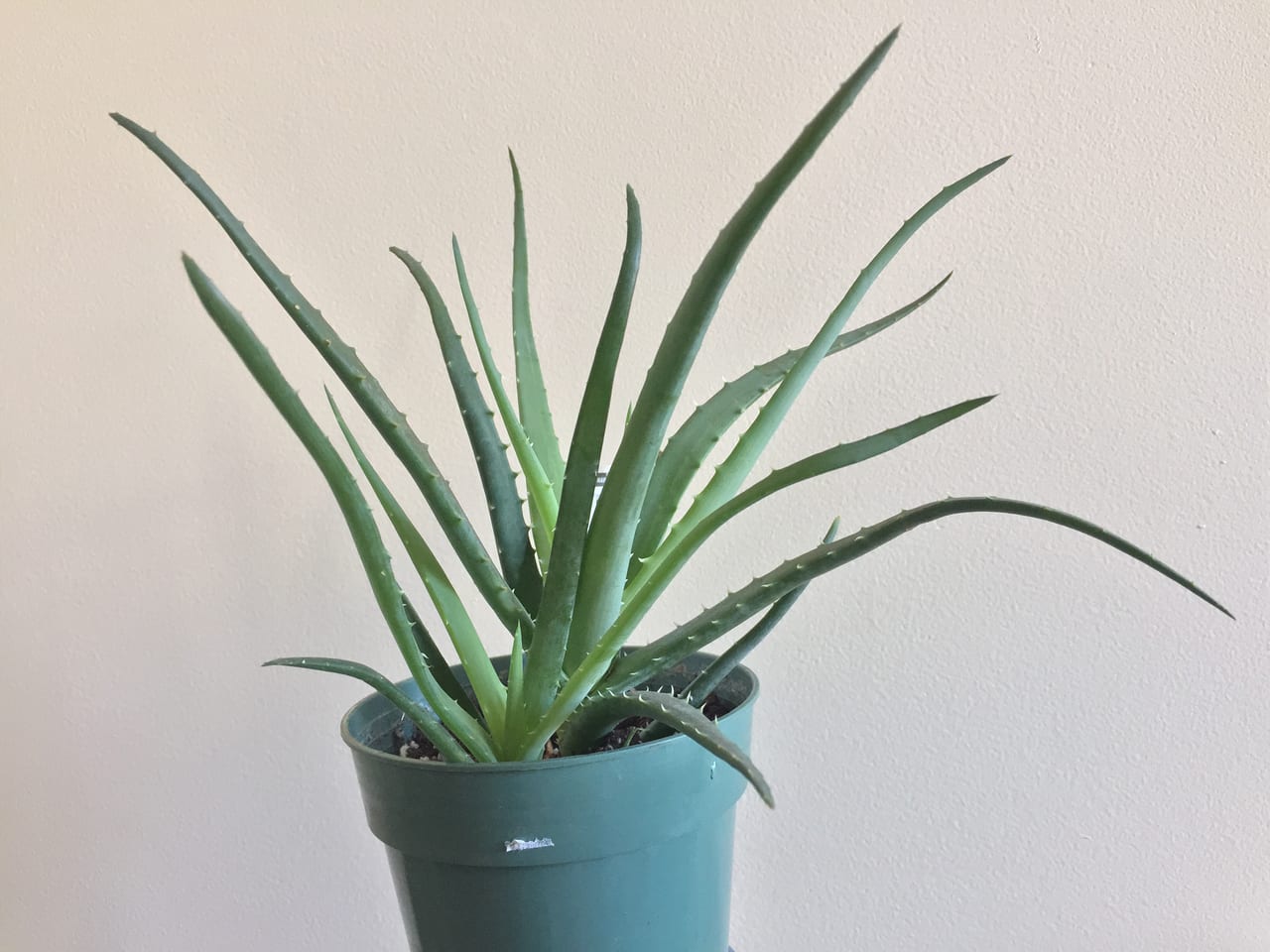
Asphodelaceae
Aloe vera
Aloe vera
The medicinal and indestructible plant. Soothing gel for burns, succulent surviving neglect. Toxic to pets.
- Difficulty Easy
- Light Bright indirect
- Watering Sparse
- Toxicity Toxic to cats
© Krish Dulal, CC BY-SA 4.0
Family
Asphodelaceae
Origin
Arabian Peninsula, Northeast Africa
- succulent
- medicinal plant
- easy
- tolerant
- houseplant
- depurative
The plant that heals and lasts
Aloe vera is one of the very few plants combining three major qualities: medicinal uses recognized since Antiquity, near-zero indoor maintenance, and easy propagation by offsets. These three characteristics make it the world’s most popular succulent, ahead of agave and yucca.
Native to the Arabian Peninsula and Northeast Africa, aloe vera has been cultivated for over 6,000 years. Egyptians called it “the plant of immortality” for its role in funeral rituals. Cleopatra reportedly used its gel daily on her skin. Today, aloe vera is found in thousands of cosmetic products, after-sun, burn care gels, and dietary supplements.
Botanically, aloe vera (Aloe vera, formerly Aloe barbadensis) is a succulent plant of the Asphodelaceae family, formerly classified as Liliaceae. Its thick fleshy sword-shaped leaves can reach 60-90 cm long on an adult plant. Inside the leaves, two distinct substances: a transparent gel (90% water, vitamins, minerals, polysaccharides) at the core, and a yellow latex (containing aloin and anthraquinones) just under the green skin.
Gel and latex: two very different substances
This distinction is crucial to understanding aloe vera and its risks.
The transparent gel at the leaf core is non-toxic and even beneficial for humans. It’s what you apply on light burns, sunburn, irritations. Rich in polysaccharides (acemannan), vitamins (A, C, E), minerals (calcium, magnesium, zinc). Soothing, anti-inflammatory, hydrating effect.
The yellow latex under the green skin is toxic to cats, dogs, and potent laxative for humans. The aloin it contains is used in some pharmaceutical laxatives but discouraged for free consumption (marked side effects, banned in some countries in cosmetics).
To use the gel at home: cut a leaf at the base, let drain 15 minutes (yellow latex flows out), then scrape the transparent gel with a spoon.
Why so many choose it
Three qualities explain its massive success.
Indestructible. Survives 1 month without watering in winter, 2 weeks in summer. Tolerates heat, drought, prolonged neglect. Ideal for distracted owners or travelers.
Useful daily. A cut, light burn, insect bite: cut a leaf, apply gel. Immediate relief. Plant regrows in weeks.
Easy propagation. Regularly produces offsets (small daughter plants at the base) that you can separate and gift. An adult aloe vera produces 3-6 offsets per year in good conditions.
Light, watering, substrate
Light. Bright direct or indirect. Ideal: south or west window, or even balcony in summer (away from frost). Aloe vera loves sun. Without enough light, leaves elongate, become soft, lose their characteristic green color.
Watering. Every 14-21 days in summer, every 30-45 days in winter. Substrate must dry completely between waterings. Method: water generously when substrate is dry, drain well, empty cachepot. Overwatering = root rot = leading cause of death.
Substrate. Very draining. Mix: 50% cactus/succulent potting mix, 30% horticultural sand, 20% perlite. Pot with drainage holes mandatory. Terracotta pot preferable (dries faster than plastic).
Humidity. Low. Aloe vera tolerates dry heated apartment air without problem.
Temperature. 18-27 degrees ideal. Tolerates up to 32 in full sun. Frost-sensitive: never below 5 degrees. Outdoors, bring in by autumn.
Fertilizer. Very little. Once a month in growing season (April-September), cactus/succulent fertilizer at half-dose. Not in winter.
Growth and repotting
Moderate growth: 3-6 new leaves per year. Adult height 40-90 cm. Width 30-60 cm with offsets.
Repotting every 2-3 years, in spring. When offsets fill the pot, sign to separate or repot in larger pot.
Propagation
By offsets (king method). At the mother plant base, small daughter plants (“baby aloes”) appear regularly. When an offset has 5-10 cm and 4-5 leaves, gently separate with its own roots at repotting. Replant in small pot with dry substrate. Recovery in 2-4 weeks.
By leaf: possible but difficult. Cut a healthy leaf, let cut dry 5-7 days, plant in dry substrate. Low success rate (30%).
Common symptoms to watch
| Symptom | Likely cause | Solution |
|---|---|---|
| Soft, floppy leaves | Overwatering, rotted roots | Check roots, repot dry |
| Brown leaves, soft at base | Crown rot | Cut, sphagnum rescue |
| Red/orange leaves | Stress (intense sun, cold) | Reduce exposure |
| Long thin leaves | Light deficiency | Reposition |
| Brown dry tips | Chronic underwatering | Water more often |
A toxic plant for pets
The yellow latex under the green skin of aloe vera leaves contains anthraquinones (notably aloin) toxic to cats and dogs. Ingestion causes vomiting, sometimes bloody diarrhea, lethargy, and red-brown urine (characteristic sign of anthraquinone poisoning). Symptoms appear in 6-12 hours and last 24-48 hours.
Mortality rare but significant discomfort for the animal. Place aloe vera out of reach of cats and dogs. If ingestion, monitor for 48h, contact vet if repeated vomiting or bloody urine.
See detailed articles Aloe vera toxic to cats and Aloe vera toxic to dogs.
Diagnose this plant
-
Diagnosis
Aloe vera with brown leaves: 4 causes and solution
Brown leaves on aloe vera: sunburn, hard tap water, chronic dehydration, or cold shock. Diagnosis and action plan.
-
Care
Propagating an aloe vera: offset method, step by step
Complete aloe vera propagation guide by offsets. King method, 95% success rate, ready to gift in weeks.
-
Diagnosis
Aloe vera with soft leaves: 3 causes and rescue plan
Soft leaves on aloe vera: rotted roots in 80 percent of cases, prolonged dehydration, or thermal shock. Diagnosis and 7-day action.
-
Toxicity
Aloe vera toxic to dogs: protocol and precautions
Aloe vera TOXIC to dogs. Anthraquinones and saponins cause vomiting, diarrhea, red-brown urine. Emergency protocol.
-
Care
Watering an aloe vera: frequency, method, mistakes
Complete aloe vera watering guide. Every 14-21 days summer, 30-45 winter. Mandatory finger test. The trap: overwatering.
-
Disease
Aloe vera root rot: save the plant
Aloe vera root rot: disease #1 of the species, caused by overwatering. 4-step rescue, durable prevention.
-
Toxicity
Aloe vera toxic to cats: protocol and precautions
Aloe vera TOXIC to cats. Anthraquinones and saponins cause vomiting, diarrhea, red-brown urine. Emergency protocol.