
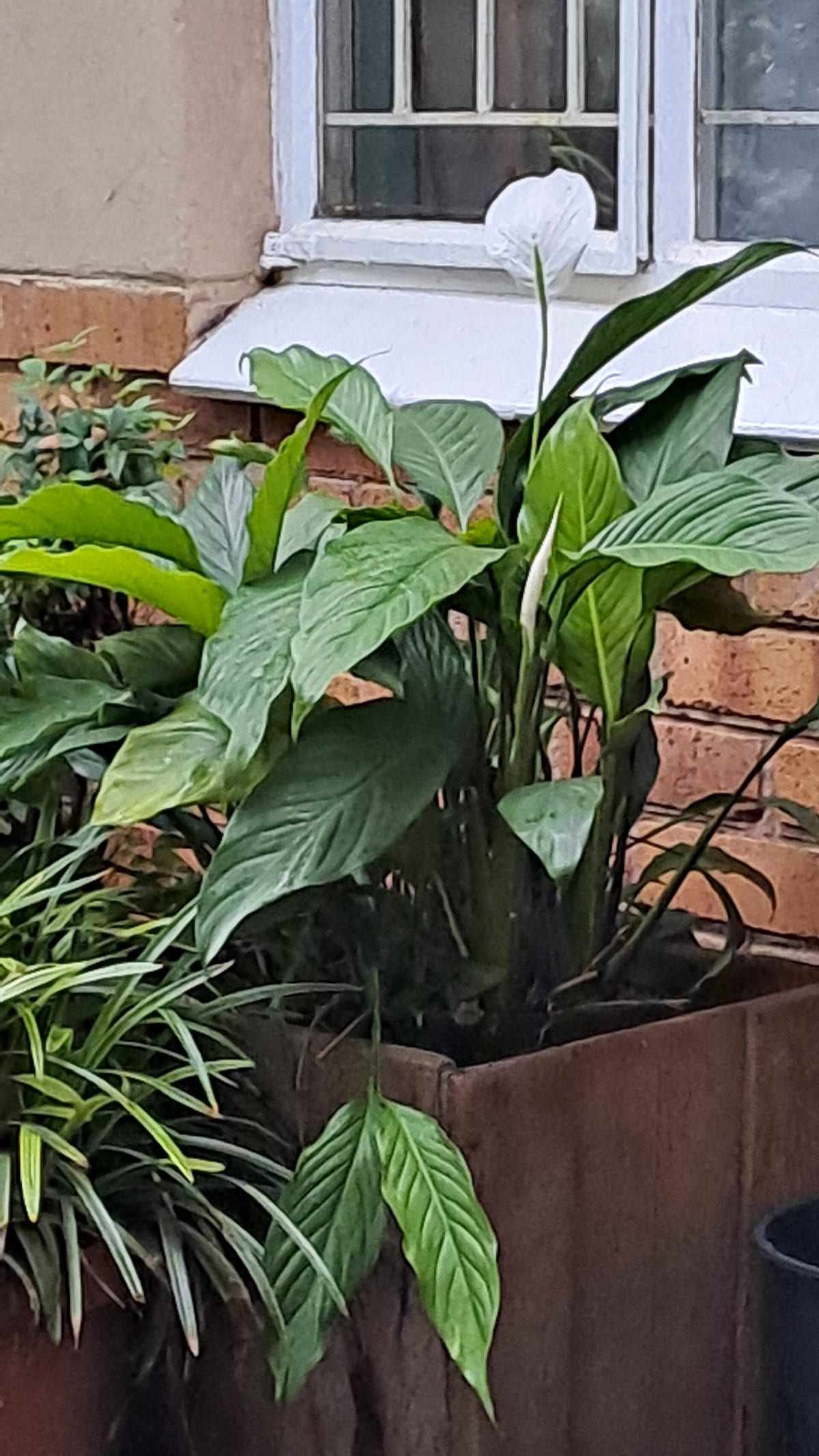
Araceae
Peace lily
Spathiphyllum wallisii
The elegant of dim corners: glossy deep green leaves, upright white spathes. Tolerates low light. Toxic to pets.
- Difficulty Easy
- Light Low
- Watering Once a week
- Toxicity Toxic to cats
© Adrienne.Warricker, CC0
Family
Araceae
Origin
Tropical forests of Central and South America
- tropical
- houseplant
- low light
- easy
- flowering
- air purifier
The plant that tells you when it’s thirsty
Spathiphyllum, commonly known as the peace lily, is one of the most practical houseplants in the world. Its particularity: leaves visibly droop when thirsty and rise back within hours after watering. One of the very few plants that communicates its needs so clearly. Perfect for beginners.
Native to the humid tropical forests of Central and South America (Colombia, Venezuela, dense Amazonian understory), Spathiphyllum naturally grows under the canopy, in constant filtered light. This adaptation explains its exceptional tolerance to low light: one of the only flowering plants that survives (and blooms) in dim apartment corners.
Its silhouette is immediately recognizable: dense clump of glossy deep green lance-shaped leaves reaching 30 to 60 cm, from which emerge in spring and summer the famous upright white spathes (the “flower”) that give the plant its name.
The spathe: it’s not a flower, it’s a bract
Botanically, the peace lily’s “white flower” is not a flower in the strict sense. It’s a spathe (modified bract) that surrounds and showcases the central spadix, a small yellow-cream stem covered with the actual tiny flowers. This characteristic structure is typical of the Araceae family (Anthurium, Monstera, Calla, Philodendron share the same floral architecture).
The pristine white spathe gradually turns pale green after 2 to 4 weeks, then darker green, then brown. This is normal. Cut the stalk at the base with disinfected scissors when the spathe has turned brown: the plant will devote its energy to producing the next.
Why so many choose it
Three characteristics explain its massive success.
Tolerates low light like no other flowering plant. Survives and blooms even 3-4 meters from a window, in a hallway, or in a dimly lit bathroom. Most flowering plants require lots of light to bloom: not the peace lily.
Visibly indicates when thirsty. Leaves dramatically droop when the substrate is dry. A few hours after watering, they rise back. No other plant gives such a clear signal. Ideal for the distracted.
Reblooms regularly. 2 to 4 flowering cycles per year in good conditions. Each cycle lasts 2 to 4 months. Plant almost always in bloom.
Light, watering, substrate
Light. Low to moderate indirect. Ideal: 1-3 meters from an east or north window. Tolerates the low light of a hallway with a distant small window. Direct south sun to avoid (leaves brown and discolor within hours).
Watering. Every 5 to 7 days in summer, every 8 to 12 days in winter. Substrate should stay slightly moist. Unmatched visual indicator: if leaves start drooping, it’s time to water. Monitor to avoid letting this signal settle in (repeated delays weaken the plant long-term). Rainwater or filtered water preferable, limescale browns the tips.
Substrate. Light and draining. Mix: 50% green plant potting mix, 30% perlite, 20% coconut fiber. Pot with drainage holes mandatory.
Humidity. Moderate to high ideal (50-70%). Tolerates apartment air (40-50%) but tips brown long-term in heated winter. Misting 1-2 times a week or humidifier recommended.
Temperature. 18 to 26 degrees ideal. Not below 12 degrees. Sensitive to cold drafts.
Fertilizer. Once a month in growing season (April-September), green plant or flowering plant fertilizer at half-dose. Not in winter.
Growth and care
Moderate growth: 4 to 8 new leaves per year in good conditions. Adult height 30 to 90 cm depending on cultivar (from 30 cm nano to 1 meter giant).
Repotting every 2 to 3 years, in spring. When roots come out of drainage holes, repotting signal. Choose pot 2-3 cm larger.
Division: the propagation method. At repotting time, gently separate the root ball into 2 to 4 sections with their own roots. Replant each section in its pot. Recovery guaranteed.
Common symptoms to watch
| Symptom | Likely cause | Solution |
|---|---|---|
| Drooping leaves | Lack of water (most often) | Water, wait 6-12h |
| Yellow leaves | Excess water or aging | Space out, check roots |
| Brown tips | Hard water or dry air | Filtered water, humidify |
| No flowers | Lack of light or fertilizer | Reposition, fertilize |
| Green spathes upon opening | Light too low | Reposition |
| Mealybugs | Dry air, isolation | Insecticidal soap treatment |
A toxic plant for pets
Like all Araceae (Anthurium, Monstera, Pothos, Dieffenbachia, Calla), Spathiphyllum contains calcium oxalate crystals in all its parts (leaves, stems, spathe, spadix, roots). Ingestion by cat or dog causes intense immediate oral irritation, excessive salivation, vomiting, sometimes mild edema. Symptoms last 24-48 hours, mortality rare but marked discomfort.
Place the plant out of reach of pets and young children. The white spathe, aesthetically attractive, is particularly tempting for curious cats. See detailed articles Peace lily toxic to cats and Peace lily toxic to dogs.
Diagnose this plant
-
Diagnosis
Peace lily brown tips: 4 causes (tap water mostly)
Brown tips on Peace lily: hard water in 50 percent of cases, dry air, over-fertilization, or exposure. Diagnosis and corrective plan.
-
Diagnosis
Peace lily drooping leaves: 4 causes (water in 80% of cases)
Drooping leaves on Peace lily: lack of water in 80 percent of cases, but also overwatering, damaged roots, or thermal shock. Exact diagnosis.
-
Diagnosis
Peace lily not flowering: 5 causes (light mostly)
Peace lily without flowers: lack of light in 60 percent of cases, lack of fertilizer, plant too young, winter rest, or pot too large.
-
Disease
Mealybugs on Peace lily: eliminate in 4 weeks
Mealybugs on Peace lily: recognize white cottony clusters, treatment with insecticidal soap + alcohol, prevention. Complete guide.
-
Toxicity
Is Peace lily toxic to cats? (yes, calcium oxalates)
Peace lily is toxic to cats. Calcium oxalate crystals throughout the plant. Symptoms, emergency steps, safe alternatives.
-
Toxicity
Is Peace lily toxic to dogs? (yes, calcium oxalates)
Peace lily is toxic to dogs. Calcium oxalate crystals throughout the plant. Symptoms, emergency steps, safe alternatives.
-
Care
Watering a Peace lily: exact frequency, signals, ideal water
Every 5-7 days in summer, 8-12 days in winter. Rainwater or filtered. Plant visibly signals when thirsty. Complete method.
-
Diagnosis
Peace lily yellow leaves: 4 causes (water in 60% of cases)
Yellow leaves on Peace lily: overwatering in 60 percent of cases, aging, lack of light, or nutrient deficiency. Stop the yellowing.